



If you’re an Ohio homeowner, you’ve probably noticed one thing: your electric bill isn’t getting any cheaper.
And every time you look into solar, the same thought hits: “Sounds great… but isn’t it expensive?”
Here’s the truth most people miss, going solar doesn’t always mean paying a huge upfront cost.
With solar leasing, you can start lowering your monthly energy bills without the big investment. But is it actually worth it for your home? What will you really pay? And how does it compare to owning your system long-term?
In this complete guide, we break it all down, so you can decide if solar leasing is the smart move for your home, your budget, and your future.
Why Ohio Homeowners Are Rethinking Their Energy Bills
Ohio electricity rates have climbed steadily for years, and for the average homeowner paying $130 to $180 per month, that trend shows no sign of reversing. When you calculate your solar savings against what you will spend on electricity over the next two decades, the math quickly becomes impossible to ignore.
But going solar has traditionally required a significant upfront investment, anywhere from $15,000 to $30,000. That is exactly where solar leasing changes the equation. With zero upfront solar installation, you can have a fully operational solar system on your home without a large payment. No down payments, just a fixed monthly lease payment that is often lower than your current electricity bill.
This guide breaks down everything you need to know: how much you can save with solar leasing, what a solar lease savings breakdown looks like for a typical Ohio home, how to compare solar leasing vs buying panels, what solar lease agreement details to watch for, and how to find the best solar leasing companies in Ohio for your specific situation. By the end, you will have a clear, honest picture of whether solar leasing is the right move for your household.
What Is Solar Leasing?
Solar leasing is a financing arrangement where a solar energy provider installs a photovoltaic (PV) system on your home and retains ownership of the equipment. You pay the provider a fixed monthly fee for the right to use the electricity the system generates. As energy costs go up, your lease payment stays lower than your electric savings.
Think of it like leasing a car: you get all the day-to-day benefits, and you make regular payments, but the system belongs to the company at the end of the term. The trade-off is attractive: you get solar with zero upfront cost, and the provider handles all maintenance for the duration of the contract.
Key Characteristics of a Solar Lease
- $0 down - zero upfront solar installation covered entirely by the provider
- Fixed monthly lease payment
- The solar company owns, insures, and maintains the system
- Lease terms typically run 15 to 25 years
- You benefit from lower electricity bills starting on day one
In Ohio, you can finance solar panels in a few different ways, including leasing, buying with cash, and taking out a solar loan. If you are deciding between leasing and owning, the main thing to consider is whether you value upfront savings and simplicity or want to get the most out of long-term ownership. This guide will explain each option in detail.
How Solar Leasing Works: A Step-by-Step Overview
Getting started with solar leasing in Ohio is simpler than most homeowners expect. Here is the full process from first contact to ongoing savings:
- Home Evaluation: A solar specialist assesses your roof, orientation, shading, and energy usage to determine your home's solar potential and the right system size.
- Custom System Design: The provider designs a solar array tailored to your roof layout and energy profile.
- Zero Upfront Solar Installation: The lease provider purchases all equipment and handles the full installation at their expense. You pay nothing out of pocket.
- Grid Connection and Monitoring: Once activated, your system begins generating electricity. Most providers include real-time monitoring so you can track output and savings.
- Fixed Monthly Lease Payments Begin: A predictable monthly payment replaces or significantly reduces your traditional utility bill.
- Solar vs. Utility Bill Comparison Begins: From month one, you can see directly how your new combined energy costs compare to what you were paying before.
- All Maintenance Handled by Provider: Equipment failures, inverter replacements, and panel issues are covered at no additional cost to you throughout the lease.
- End-of-Term Options: Renew, purchase the system at fair market value, or have panels removed at no charge.
The main benefit of this structure is that it is predictable. You always know what your monthly payment will be for the entire lease, unlike utility bills that can change with the seasons, your usage, or rate increases.
Solar Leasing Cost Comparison: What You Will Actually Pay and Save
Before making any decisions, it’s important to compare the costs of solar leasing. Here is a realistic breakdown of how much a typical Ohio homeowner could save with a solar lease over time.
[Video Embed: https://youtu.be/MEyJd8Y9AVk ]
Typical Solar Lease Plans and Pricing in Ohio
In Ohio, most solar lease payments fall between $80 and $150 per month, depending on the size of the system, the provider, and where you live. For a typical home with a 6 kW to 8 kW system, you can usually expect to pay between $90 and $130 each month. These numbers give you a good idea of what to expect before you get a personalized quote.
Solar vs. Utility Bill Comparison
The table below shows a clear breakdown of solar lease savings for a typical Ohio homeowner. It highlights how much you could save with a solar lease, both now and in the future.
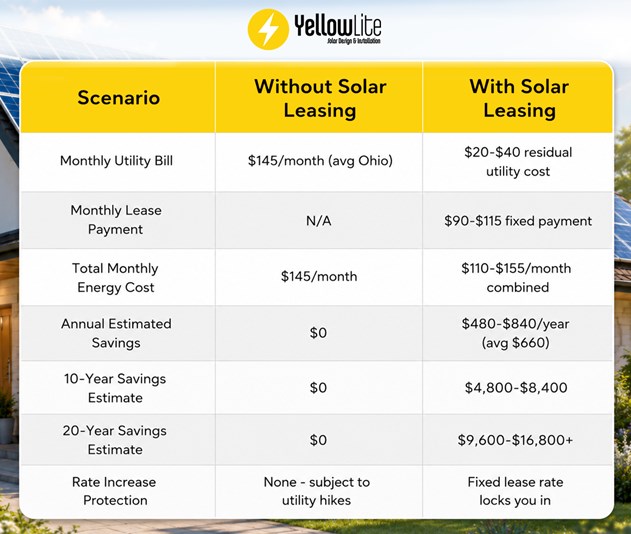
As utility rates in Ohio keep going up, the difference between your old bills and your new ones gets bigger each year. This means your savings from solar leasing will keep increasing over time.
Lock Your Electricity Rate Today
Each month you stay with your current utility, your energy costs can go up without warning. By leasing solar with a fixed monthly payment, you set your electricity rate now. While others face future utility increases, you avoid them.
Compare Solar Leasing vs. Buying Panels: The Full Breakdown
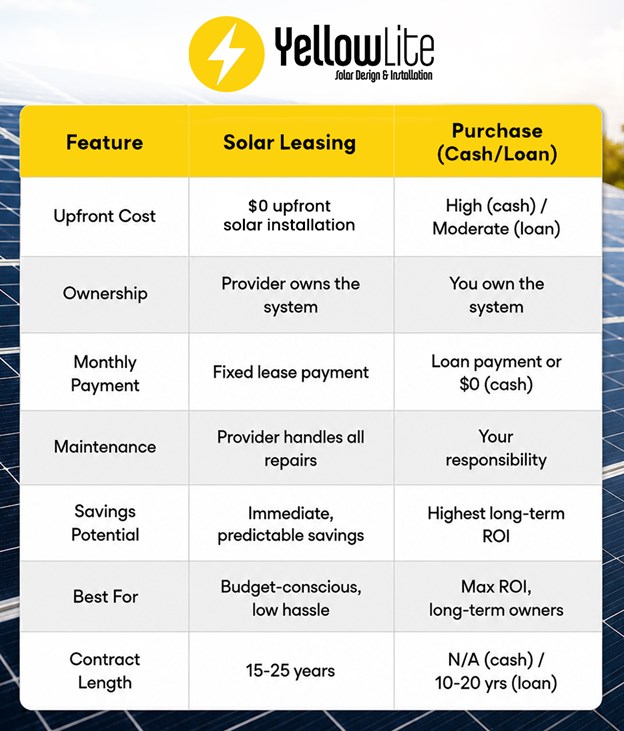
When homeowners ask how to compare solar leasing vs buying panels, the honest answer is: it depends on your priorities. The solar lease vs loan vs cash decision is one of the most consequential financial choices in the solar process and each path leads to meaningfully different outcomes.
Here is a comprehensive solar leasing cost comparison across all three major solar financing options in Ohio:
When Leasing Makes the Most Sense
- You want to switch to solar and start saving with $0 upfront cost
- You prefer fixed, predictable monthly payments over large capital outlays
- You want zero upfront solar installation without the wait of securing a loan
- You prefer a maintenance-free arrangement with no system ownership responsibility
- You are a first-time solar adopter exploring solar financing options in Ohio for the first time
When Buying or a Solar Loan Is Better
- You want to maximize long-term ROI
- You plan to stay in your home for 20 or more years
- You have strong credit and access to low-rate financing
- Building equity in a home energy asset matters to you
There is no single right answer. Leasing vs owning solar panels in Ohio is ultimately a personal financial decision. What matters is that you compare solar lease companies and financing options side by side with real numbers, not just marketing headlines.
Pros and Cons of Solar Leasing
Advantages
- Zero upfront cost - get solar with zero upfront cost and immediate savings from day one
- Predictable fixed monthly payments - no seasonal surprises or fluctuating energy bills
- Maintenance-free - provider handles all repairs, replacements, and monitoring at no extra charge
- Fast setup - solar installation in Columbus Ohio and across the state can often begin within weeks
- Immediate solar vs utility bill savings - your combined energy costs are often lower from month one
- No performance risk - if output underperforms, the provider is accountable
Disadvantages
- No ownership, you do not build equity in the solar asset
- Lower long-term ROI compared to a cash purchase
- Long contract commitment of 15 to 25 years
- Home sale complexity - lease transfer requires buyer qualification
- Escalator clauses - one of the key hidden costs of solar leasing to watch for
For most Ohio homeowners prioritizing affordability, simplicity, and fast entry into solar, the advantages outweigh the limitations. But going in fully informed, especially about the hidden costs of solar leasing like escalator clauses and transfer fees, is essential before you sign.
Solar Lease Agreement Details: What to Read Before You Sign
Understanding your solar lease agreement details protects you from surprises down the road. Here is a clear breakdown of the key provisions in any solar lease contract:
-
Lease Duration
Most solar leases run 15 to 25 years. This is a significant long-term commitment - review the full term and confirm the economics hold up even at projected future utility rates.
-
Escalator Clauses - The Most Important Hidden Cost of Solar Leasing
Escalator clauses are one of the most under-discussed hidden costs of solar leasing. This provision allows your monthly payment to increase by a fixed percentage each year - typically 1% to 3%. Over 20 years, this compounds meaningfully. Always ask for the exact escalator rate and model out what you will pay in year 10 and year 20. This detail should appear clearly in any legitimate solar lease plans and pricing document.
-
Maintenance and Coverage Scope
A well-structured lease should include comprehensive coverage: panel cleaning, inverter replacement, wiring repairs, and performance monitoring. Confirming this upfront is one of the clearest ways to avoid bad solar leasing companies - providers that offer vague or limited maintenance terms are a red flag.
-
Transferring the Lease When Selling Your Home
If you sell during an active solar lease, you can typically transfer it to a qualified buyer or buy it out. Many buyers view solar leasing plans in Columbus and other Ohio metros as a genuine selling point because of the lower utility bills the system provides. Confirm the transfer process and any associated fees with your provider before signing anything.
-
End-of-Term Options
At the end of your lease you can renew, purchase the system at fair market value, or have it removed at no cost. Most homeowners choose to renew or buy; by that point, the system has a solid performance record and purchasing is often the financially sensible next step.
Trusted solar leasing companies in Ohio, including YellowLite, walk every client through these terms transparently, with no fine-print surprises.
Net Metering and Solar Leasing in Ohio
Ohio's net metering policy allows you to earn bill credits for any excess electricity your solar system sends back to the grid. Even as a lessee - not an owner - you keep the full benefit of those credits, which directly reduces your utility charges on top of your lease savings.
On high-production days, your system may generate more power than your home uses. That surplus flows to the grid, and your utility company credits your account for this energy. In winter months when production dips, those banked credits help offset remaining utility charges. The result is a stronger overall solar vs utility bill comparison in your favor year-round.
Ohio Net Metering Benefits for Solar Lessees
- Ohio utilities are required to offer net metering to eligible solar customers
- Credits apply at the full retail electricity rate - not a reduced wholesale rate
- Banked credits roll over month to month, maximizing value across seasons
- Combines with your fixed lease payment to minimize total energy costs
- Strengthens the real savings from solar leasing significantly over time
A well-sized system designed by experienced solar leasing companies in Ohio - like YellowLite - will maximize net metering value for your specific home, usage patterns, and grid connection.
Is Solar Leasing Right for You? Who Benefits Most
Solar Leasing Is Ideal If You:
- Have high monthly electricity bills and want to switch to solar and start saving right away
- Want to get solar with zero upfront cost - no large payments, no financing hurdles
- Prefer a hands-off, maintenance-free solar experience
- Plan to stay in your home for 5 to 15 years
- Are exploring solar leasing options in Columbus Ohio or anywhere in the state for the first time
- Want to lock your electricity rate today and protect against future utility increases
Solar Leasing May Not Be Ideal If You:
- Are focused primarily on long-term ROI
- Plan to stay in your home for 20 or more years and can comfortably afford a purchase
- Prefer to own your home energy assets outright with no long-term contract
The right choice is different for every homeowner. A good solar provider will not push you toward any single option - they will help you compare solar lease companies, loan products, and purchase scenarios with real numbers so you can make an informed decision.
How to Choose the Right Solar Lease Provider in Ohio
Knowing how to choose the right solar lease provider is just as important as understanding the lease itself. Not all solar leasing companies in Ohio operate with the same level of transparency, service quality, or long-term commitment, and since you are entering a 15 to 25-year agreement, getting this right matters enormously.
What Separates the Best Solar Leasing Companies in Ohio from the Rest
- Experience and local track record: Look for established, trusted solar leasing companies in Ohio with a proven history of solar installation in Columbus Ohio and across the state - not out-of-state operations that will not be around when you need service.
- Transparent solar lease plans and pricing: The best solar lease options in Ohio come with clear, written terms. No mystery around escalator rates, transfer fees, or end-of-term costs.
- No hidden fees: This is the clearest sign to avoid bad solar leasing companies. Any provider that is vague about contract details or fees before signing is a warning sign.
- Comprehensive maintenance: Top solar leasing providers near you should cover all repairs, monitoring, and equipment replacement for the full lease term.
- Flexibility: Can you buy out the lease? Can it be transferred if you sell? Do they offer multiple solar leasing plans in Columbus and other Ohio cities?
- Responsive local support: Can you reach a real Ohio-based person when something goes wrong - not a distant call center?
How to Compare Solar Lease Companies
When you compare solar lease companies, do not stop at the monthly payment. Ask each provider for: the full escalator schedule over the lease term, the buyout formula at years 5, 10, and 15, the transfer process and any associated fees, and the exact scope of maintenance coverage. This is how you find the best solar leasing companies in Ohio rather than simply the most advertised ones. Zero down solar lease providers vary significantly in contract quality - read carefully.
YellowLite has been helping Ohio homeowners find the best solar lease options in Ohio for over a decade. As one of the most trusted solar leasing companies in Ohio, we offer clear solar lease plans and pricing, no hidden fees, full maintenance coverage, and locally backed support from a team that understands Ohio's utilities, grid, and net metering policies inside and out.
Solar Leasing in Ohio: Local Trends and Why It's Growing
Ohio's solar market has grown considerably over the past decade, and solar leasing has been a primary driver of that expansion. By removing the upfront cost barrier, zero down solar lease providers have brought solar energy within reach for thousands of Ohio homeowners who would otherwise have been priced out.
Why Solar Leasing Is Accelerating Across Ohio
- Ohio electricity rates have risen nearly 20% over the past five years, widening the solar vs utility bill comparison gap in favor of solar
- Ohio's net metering policy makes solar leasing financially attractive throughout the year
- Columbus, Cleveland, Dayton, and Cincinnati all have strong solar potential despite Ohio's mixed reputation for sunshine
- Solar leasing options in Columbus Ohio have become increasingly competitive, with more top solar leasing providers near you offering zero down plans
- Growing awareness of the real cost of staying on utility power is driving more homeowners to explore solar financing options in Ohio
Solar Leasing Plans in Columbus and Central Ohio
Central Ohio is one of the fastest-growing solar markets in the Midwest. Solar installation in Columbus Ohio has surged, with thousands of homeowners choosing zero upfront solar installation to lock in predictable, lower energy costs. YellowLite serves Columbus, Cleveland, Cincinnati, Dayton, and surrounding communities with Ohio-tailored solar leasing plans and direct support from a locally based team.Whether you are evaluating solar leasing options in Columbus Ohio, comparing zero down solar lease providers in Cleveland, or looking at solar leasing plans in Columbus for the first time, the economics are increasingly compelling. Rising utility rates, strong net metering, and competitive solar lease plans and pricing have created an ideal environment for Ohio homeowners to switch to solar and start saving - often with no money down.
Ready to Switch to Solar and Start Saving?
Every month you stay on traditional utility power is another month of unpredictable, rising energy costs. Solar leasing eliminates that uncertainty - starting with zero upfront solar installation and a fixed monthly payment that you control from the day you sign.
With YellowLite, Ohio homeowners can:
- Get solar with zero upfront cost - no large payments, no financing headaches
- Lock your electricity rate today and protect yourself from all future utility increases
- Calculate your solar savings with a personalized estimate based on your home and actual usage
- See if your home qualifies for solar leasing with a same-week evaluation
- Find the best solar plan for your budget and goals with transparent, no-pressure guidance
- Switch to solar and start saving within weeks of signing
YellowLite is one of the most trusted solar leasing companies in Ohio - and we are committed to making your transition to solar simple, transparent, and genuinely worthwhile. No pressure sales, no fine print, no surprises.

See if your home qualifies for zero down solar leasing in Columbus, Cleveland, Dayton, Cincinnati, and across Ohio.
Frequently Asked Questions About Solar Leasing in Ohio
Q1. Is solar leasing worth it in Ohio?
For most Ohio homeowners, yes. If you want to check your solar savings in Ohio without a large upfront investment, leasing is a practical, low-risk entry point. You may not capture the maximum ROI of ownership, but the immediate monthly savings and zero cost to start make it worthwhile - especially as Ohio utility rates keep climbing.
Q2. How much can I save with solar leasing?
When you do a solar lease savings breakdown, most Ohio homeowners save between $500 and $1,500 annually. The real savings from solar leasing accumulate over years - and since your lease payment is fixed while utility rates rise, the gap between what you pay and what non-solar neighbors pay tends to grow over time.
Q3. Can I sell my home with a solar lease?
Yes. You can transfer the lease to a qualified buyer (many see it as a selling point due to lower energy bills) or buy out the remaining lease. Review your solar lease agreement details before listing your home so you are fully prepared for either scenario.
Q4. What happens after the lease ends?
At end of term you can renew, purchase the system at fair market value, or have panels removed at no cost. Most homeowners renew or buy - by then, purchasing the system usually makes strong financial sense given its proven track record.
Q5. Is maintenance included in a solar lease?
Yes - this is one of the key advantages. Your provider handles all repairs, monitoring, and equipment replacement throughout the lease term. No surprise bills for inverter failures or panel issues.
Q6. What are the hidden costs of solar leasing?
The main hidden costs of solar leasing to watch for are: escalator clauses (annual payment increases of 1-3%), transfer fees if you sell your home, and end-of-term buyout pricing. Read your solar lease agreement details carefully and ask providers to spell out every fee before signing.
Q7. Does solar leasing qualify for the federal tax credit?
No, because the provider owns the system, they claim the 30% ITC, not you. If maximizing tax benefits matters, compare solar leasing vs buying panels or explore a solar loan where you retain ownership and the full credit.