
Ohio homeowners are going solar at a faster pace than ever, and it's easy to see why. Between rising utility rates and improving technology, solar makes long-term financial sense. But one thing still stops many homeowners from making the switch: the upfront cost of purchasing a system outright.
That's where solar leasing comes in. Solar leasing is one of the most accessible financing options available, allowing you to get panels on your roof with no money down. In this guide, you'll learn how solar leasing works, what solar panel lease costs look like in Ohio, how plans from different solar leasing companies compare, and what to ask before signing on the dotted line.
What Is Solar Leasing?
A solar lease is an agreement in which a third-party solar company owns the panels installed on your roof, and you pay a fixed monthly fee to use the electricity they generate. You don't own the system, you're essentially renting it.
Lease terms typically run 15 to 25 years. During that period, the solar provider handles equipment ownership, and in many cases, maintenance. At the end of the lease, you usually have the option to renew, buy the system at fair market value, or have the panels removed.
The key difference between leasing and owning comes down to who captures the financial benefits. Owners claim tax credits and depreciation. Lessees trade those incentives for simpler access, fixed energy cost, and lower upfront costs.
Average Solar Panel Lease Cost in Ohio
The average monthly solar panel lease cost in Ohio ranges from $50 to $200 per month, depending on several variables. Most homeowners fall somewhere in the $80–$150 range for a typical residential system.
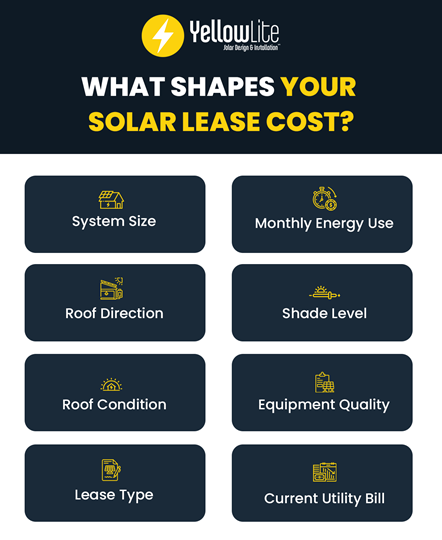
Factors that affect your lease pricing include:
- System size - A larger system producing more kilowatt-hours carries a higher monthly payment.
- Energy usage - Your historical utility consumption how many solar panels you need.
- Roof condition and orientation - A south-facing roof with minimal shading requires fewer panels to hit your energy targets, which can lower costs.
- Equipment quality - Premium panels and inverters cost more but often come with better performance guarantees.
- Lease structure - Fixed-rate leases differ from escalating-rate agreements (more on that below).
The goal is for your lease payment to be lower than what you currently pay the utility. If your monthly electric bill is $160 and your lease payment would be $110, you're saving money from day one.
Types of Solar Leasing Plans
Different solar leasing companies offer different plan structures. Understanding each type helps you compare offers on equal footing.
Fixed Monthly Lease
A fixed lease locks in your monthly payment for the full term. Your payment doesn't change year over year, making budgeting straightforward and predictable. This is the most common lease structure and generally preferred by homeowners who want simplicity.
Escalator Lease
An escalator lease starts with a lower monthly payment, but increases annually, typically 1–3% per year. The goal is for your payment to escalate slower than utility rate inflation, which in Ohio has averaged 5% each year over the last 25 years.
How to Choose Among Solar Leasing Companies
Not all solar leasing companies offer the same terms, equipment, or service quality. Here's a short checklist to use when evaluating your options:
- Company experience — How long have they been operating in Ohio? A company with years of local installs will be better equipped to navigate your utility's net metering policies and regional permitting requirements.
- Financing transparency — Are the full lease terms, escalator rates (if any), and buyout options clearly explained before you sign?
- Equipment brands — Are they using tier-1 panels with strong efficiency ratings and long warranties?
- Warranty coverage — What's covered, and who do you call if something breaks five years in?
- Customer reviews — Look for verified reviews on Google, the BBB, and the Solar Energy Industries Association (SEIA) directory.
- Local expertise — A local installer will be experienced with Ohio utility territory and net metering rules in a way that national companies often don't.
Choosing a solar leasing partner isn't just about the monthly rate. The company managing your system for the next two decades matters as much as the price.
Solar Financing Alternatives in Ohio
Leasing is one of several paths to solar. Understanding all your options makes for a better decision.
- Cash Purchase is the highest upfront cost but the best long-term return. No monthly payments, and maximum lifetime savings.
- Solar Loans allow you to own the system while spreading payments over time. Once the loan is paid off, your electricity is effectively free. Monthly payments are comparable to leasing, however, sometimes they can be higher than a lease.
- Solar Lease as covered above offers $0 down and low monthly payments, at the cost of ownership benefits.
For homeowners in central Ohio, exploring solar installation in Columbus Ohio gives you access to all three of these options, along with local expertise on which structure fits your energy usage and budget.
Conclusion
Solar leasing is a legitimate and practical way to access solar energy without a large upfront investment. It works best for homeowners who prioritize simplicity, want predictable monthly solar leasing savings, and want energy savings starting day one.
The right choice depends on your financial situation, how long you plan to stay in the home, and what matters most to you.
Before committing to any solar financing structure, comparing solar leasing companies and all available options side by side is essential.
YellowLite has helped Ohio homeowners evaluate and install solar for over a decade. Whether you're leaning toward leasing, interested in a solar loan, or want to understand the full picture before deciding, our team can walk you through every option with no pressure. Talk to a YellowLite solar advisor to get a personalized quote and financing comparison for your home.
FAQ
1. What is the average solar panel lease cost in Ohio?
The average solar panel lease cost in Ohio is between $80 and $150 per month for a typical residential system. The exact amount depends on your system size, energy usage, roof conditions, and the lease structure (fixed vs. escalator). Most homeowners see a monthly lease payment that is lower than their current electric bill starting day one.
2. How long does a solar lease last?
Most solar leases run for 15 to 25 years. At the end of the term, you typically have three options: renew the lease, purchase the system at fair market value, or have the panels removed at no cost.
3. Do leased solar panels require maintenance?
In most cases, maintenance is covered by the leasing company, since they own the equipment. If a panel underperforms or an inverter fails, the lessor is responsible for repair or replacement. Always confirm what's included before signing.
4. Can I buy out my solar lease later?
Most solar lease agreements include a buyout option, typically available after a set number of years. The buyout price is usually based on fair market value of the system at that time. Review the buyout terms in your contract carefully before signing.
5. Is solar leasing better than buying?
It depends on your priorities. Leasing offers lower upfront costs and easier access to solar technology, but purchasing a system, whether with cash or a loan, typically delivers higher lifetime savings. For most homeowners with the financial flexibility to buy, ownership is the better long-term investment.