

You may be ready to put your roof to work, but paying for an entire solar system at once can feel like a big step. Perhaps you would rather keep savings available for retirement, home repairs, or unexpected expenses. That is where solar panel financing becomes worth exploring.
Ohio homeowners can compare borrowing to own a system, leasing panels, or buying outright. Each approach changes your upfront spending, monthly commitments, and long-term responsibilities. Before choosing residential solar panels, it helps to understand what you are paying for, who owns the equipment, and how the arrangement fits your household budget.
What Are the Different Types of Solar Panel Financing Options?
What are your options if you don’t want to pay the full cost for solar upfront? A loan lets you spread the cost of ownership, while a lease lets you use provider-owned panels.
Here’s how both compare versus buying outright.
Buying outright: pay once and own the system
When you purchase your solar system, you own the equipment outright. You generally experience a better payback on your solar system too, because you are not getting charged for interest or finance fees. However, it does require a large upfront payment.
Solar Loan: spread the cost of ownership
A solar loan lets you buy the system and repay the borrowed amount over an agreed period. Some lenders offer options for zero money down.
You own the panels, while repairs and equipment issues are handled according to applicable warranties and service agreements.
Solar leases: use the panels without buying them
With solar leasing, a provider owns the equipment, and you make scheduled payments to use it. Some plans require no upfront payment. Maintenance is typically handled by the provider within the agreement’s coverage. Review exclusions, annual payment increases, and end-of-term options.
|
Option |
Who owns the panels? |
How you pay |
Main consideration |
|
Cash purchase |
Homeowner |
Installation price upfront |
Available savings |
|
Solar loan |
Homeowner |
Down payment, if required, plus loan payments |
Interest and total repayment |
|
Solar lease |
Provider |
Scheduled lease payments |
Contract terms and service coverage |
A power purchase agreement, or PPA, is another third-party ownership arrangement. Instead of paying to use the equipment, you purchase its electricity at a contracted price per kilowatt-hour. Ask whether a PPA is available for your home.
Solar Leasing vs. Buying With Financing: Compare the Full Cost
A smaller monthly payment does not tell you the full agreement cost. Compare proposals with the same equipment, system size, and expected annual production.
For a loan, request both the cash price and financed price. Check the annual percentage rate, or APR, which reflects interest and certain borrowing charges. Also review the amount borrowed, repayment period, and total payments.
The Consumer Financial Protection Bureau’s solar financing report identifies loans with dealer fees built into the financed price. Asking for both prices helps you understand the cost of how much you are actually borrowing, and what that would look like if you want to pay the loan off early..
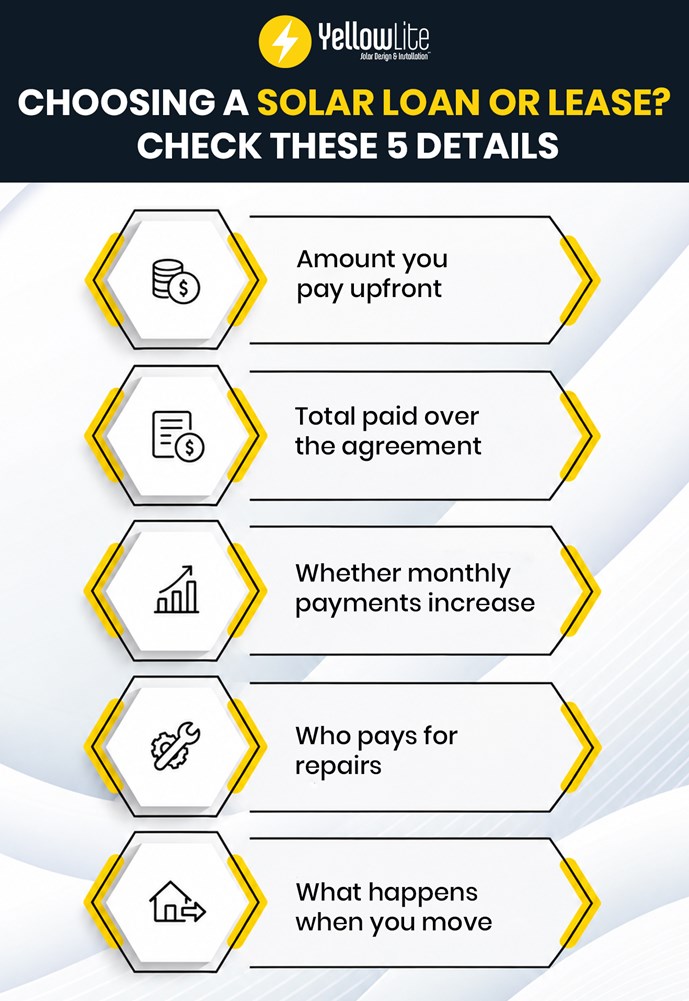
For a lease, check whether payments stay level or rise each year. Ask who handles monitoring, repairs, roof-related panel removal, and equipment replacement.
Keep your remaining utility bill in the calculation. Solar can reduce electricity purchased from the grid, but utility charges and electricity purchases may remain.
Compare these items side by side:
- Upfront spending: Include deposits and work outside the installation quote.
- Monthly commitment: Add the solar payment to the estimated remaining utility bill.
- Lifetime cost: Compare total loan repayment or lease payments over equivalent periods.
- Moving plans: Check loan payoff, lease transfer, buyer approval, and buyout requirements.
In Ohio, solar savings also depend on utility rates and credits for exported electricity. Confirm the actual terms with your utility or supplier rather than assuming exported electricity receives the full retail rate.
How Solar Loans Work and Where to Apply?
If ownership appeals to you, start with an estimate covering your solar installation and any separately priced work. That gives you a clear borrowing amount before comparing lenders.
Solar loans work like home-improvement loans: a lender reviews your application and offers repayment terms if you qualify. Approval and pricing depend on credit history, income, debt, and lender requirements.
Compare installer-arranged financing with offers from banks or credit unions. A home-equity loan may also be an option, but it uses your home as collateral. Ask each lender about security requirements and fees.
Use this checklist when getting started with solar:
- Gather your information. Have recent electricity bills, property details, and the lender’s requested income documents ready.
- Compare written offers. Review APR, fees, repayment terms, payment start dates, and early-payoff conditions.
- Check the application process. Ask whether prequalification affects your credit and whether a later application requires a hard inquiry.
- Confirm approval before committing. Use the lender’s official application channel and read the final agreement before signing.
At YellowLite, we help you explore solar financing and zero-down options for your home. Our team can walk you through available plans, upfront costs, and payment terms so you can compare your options clearly. Availability and approval depend on your location and the financing provider’s requirements.
Key Takeaways
The right payment option should fit both your finances and your plans for the home. Buying outright avoids borrowing costs. A loan spreads the purchase price while keeping ownership with you. A lease offers access to solar through a provider-owned system, with responsibilities defined by the contract.
Before deciding, ask YellowLite for a proposal grounded in roof conditions, shade, location, electricity use, and expected annual production. Its solar design and engineering process helps establish what your home can support before you compare payment options. A clear estimate and complete contract make it easier to choose a solar plan with confidence.

FAQs
1. What credit score is needed for solar panel financing approval?
There is no universal minimum across lenders. Ask for current requirements, since approval also depends on income, debt, and credit history.
2. Can I get solar panel financing with no down payment?
Some plans allow zero down, subject to approval and availability. YellowLite lists such options on its official financing page.
3. How do I apply for solar panel financing online?
Use the lender’s official website or verified application link after reviewing your estimate. Ask about credit checks before submitting.
4. Will I still receive an electric bill?
Usually, yes. Electricity purchased from the grid and applicable utility charges can remain alongside your solar payment.
5. What happens if I sell my house before the agreement ends?
Your contract determines the options, which may include payoff, transfer, or buyout. Confirm buyer-approval requirements before signing.