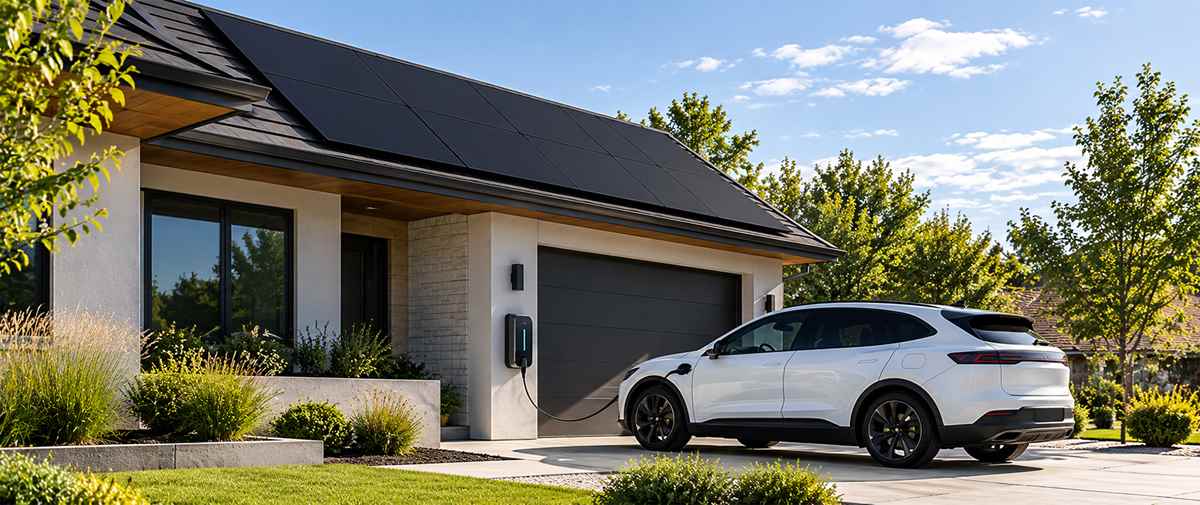


Your next car may come with a charging cable instead of trips to the gas station. But those miles still need energy, and some of that energy will show up on your home’s electric bill.
If you are considering solar now and an EV next year, bring both plans to the same conversation. Choosing solar panels for EV charging starts with understanding how your household’s electricity needs will change.
Here is how to estimate future charging needs, what to look for in solar proposals, and prepare your home for powering your home and your car off of solar panels.
How Many Solar Panels Will Your Future EV Need?
Your electric bills show what your home uses today. Your future EV adds another electricity need, and its size depends more on your driving habits than the size of its battery.
The Department of Energy recommends accounting for a planned EV purchase when calculating electricity needs for solar.
Start with 12 months of household use. Estimate annual EV needs using mileage and electricity consumption per mile, adjusting for charging elsewhere.
Illustrative example: Driving 12,000 miles annually at an assumed charging-energy consumption of 0.30 kWh per mile requires 3,600 kWh a year. If half your charging happens elsewhere, the home-charging allowance becomes 1,800 kWh. These are illustrative assumptions.
Check for included charging losses and winter driving needs.
Next, compare that allowance with the additional energy your roof could produce. So for example, if your home's annual electric usage was 11,000 kWh, then you'll want to add 3,600 kWh to that, and size your solar system off of that. Actual production must be estimated for your property.
There is no single recommended solar panel for EV charging Wattage for daily EV charging. Watts and kilowatts describe power; kilowatt-hours describe energy used or produced over time. A higher-wattage panel may reduce the panel count, but shade, orientation, and usable roof space still affect output.
Daily charging replaces energy used on recent trips. A full-battery recharge does not determine annual solar needs.
Ask for a residential solar system proposal showing household demand, expected EV charging, and modeled annual production separately.
Choosing a Solar EV Charging Setup: Costs and Savings
You do not need solar panels for EV charging labeled specifically for electric vehicles. A properly designed home solar system supplies usable electricity through an inverter, and a compatible EV charger draws electricity through your home’s electrical system.
Compare setups against your charging routine, budget, and backup priorities.
|
Setup |
How It Supports Charging |
What to Compare |
|
Grid-connected solar |
Supplies available solar during daylight; the grid covers shortfalls and nighttime charging. |
Installed cost, production, and utility export credits. |
|
Solar with charging controls |
Compatible controls can adjust charging to available solar. |
Charger compatibility, minimum charging power, and scheduling features. |
|
Solar with battery storage |
Stores some solar electricity for later use. |
Added cost, usable capacity, output, and household backup priorities. |
A battery is optional for grid-connected home charging. Battery storage allows solar energy to be used later, but its capacity must be checked against both household and vehicle needs.
How much does installing solar for home EV charging cost? There is no single installed price. Request an itemized quote covering the solar array, inverter, charger, wiring, electrical upgrades, permits, and optional energy storage. If you already have solar, ask for the incremental cost of expansion.
Solar can reduce purchased charging electricity while serving your home. Savings depend on cost, financing, production, charging times, and utility rates.
For Ohio homes charging overnight, compare daytime export credits with nighttime electricity charges. Matching annual charging use with annual solar production does not mean every charging session runs directly on sunlight.
Review solar financing options against total payments and projected savings. A lower upfront payment does not necessarily mean a lower total cost.
For installations completed after December 31, 2025, the federal Residential Clean Energy Credit under Section 25D is unavailable. Check eligibility for other incentives.
How to Plan Your Solar Installation Before Buying an EV
Begin with a vehicle shortlist. Give your installer realistic future demand and time to coordinate work.
For a home charger, the Department of Energy recommends an electrical-capacity assessment. Level 2 equipment uses 240 volts, but the appropriate charging rate depends on your daily mileage and available charging time.
Follow these steps before approving your solar installation:
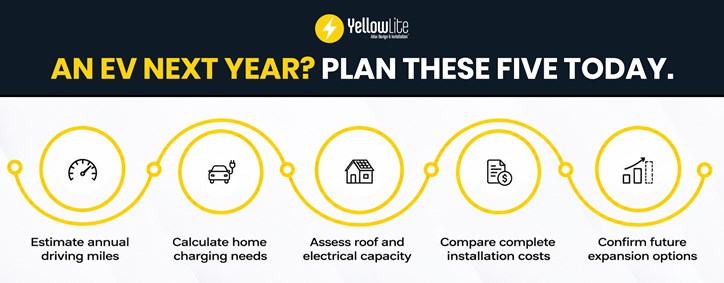
- Share your driving plan. Include annual mileage, likely vehicle models, and your home-charging share.
- Assess the property. Review roof condition, shade, available area, and planned roof repairs.
- Check the electrical setup. Have a qualified electrician assess service capacity, charger wiring, and load-management options.
- Compare installation timing. Evaluate including future EV demand now versus preparing for an approved expansion later.
- Review the written proposal. Confirm equipment, warranties, production assumptions, permits, utility requirements, and responsibility for charger work.
Compare roof fit, production, warranties, and installer support. Charger compatibility depends on vehicle connections and electrical equipment, rather than panel brands.
At YellowLite, our solar design and engineering services include production modeling and EV infrastructure planning. Discuss your charging goals with us before finalizing the layout, including any future expansion and utility approval requirements.
Key Takeaways
Buying an EV is a good reason to plan beyond today’s electric bill. Estimate how much charging will happen at home, compare suitable equipment, and request costs for the complete installation.
At YellowLite, we evaluate roof conditions, shade, location, electricity use, and expected annual production to shape a plan around your household and future EV. When getting started with solar, bring your electricity bills, vehicle shortlist, and driving estimate.
You do not have to predict every mile or select every component today. You need a clear proposal that explains what your solar system can support when your next car arrives.

FAQs
1. How much do solar panels for EV charging cost to install at home?
The price depends on system size, roof conditions, charger work, and optional storage. Request an itemized estimate for your home and projected driving needs.
2. Which solar panels for EV charging are best for an Ohio home?
Choose panels based on modeled roof production, available space, warranties, and installation quality. EV charging does not require a dedicated solar-panel brand.
3. Can solar panels for EV charging work with my existing charger?
Usually, a compatible home charger can use electricity supplied through your home’s solar and grid connection. Automatic surplus-solar charging needs compatible controls.
4. Can I install the system myself?
Home solar and charger installations involve electrical design, permits, inspections, and utility requirements. Use qualified installers to coordinate the project.
5. Are federal tax credits still available for a new home charger?
The Section 30C credit is unavailable for charging equipment placed in service after June 30, 2026. Verify any other offers separately with their program provider.