

When businesses consider solar energy, they’re often focused on the equipment, incentives, and projected savings. But in the realm of commercial solar installations, one factor stands out above the rest: the choice of your solar provider. The right partner can unlock maximum financial and operational value; the wrong one can reduce savings, delay payback, and complicate maintenance.
This article explores how those decisions influence your return on investment (ROI) on solar panel installation.
What Does Solar Panel ROI Mean for a Business?
Solar panel ROI measures the financial return a business receives compared with what it spends on a solar energy system.
For commercial properties, that return is shaped by more than panel price. Electricity rates, annual energy use, system production, financing, incentives, and operating costs all affect how quickly the project creates value.
That is why similar-sized systems can produce different results. A useful forecast should be built around actual utility bills, energy use, and project assumptions.
Which Factors Have the Biggest Impact on Solar Panel ROI?
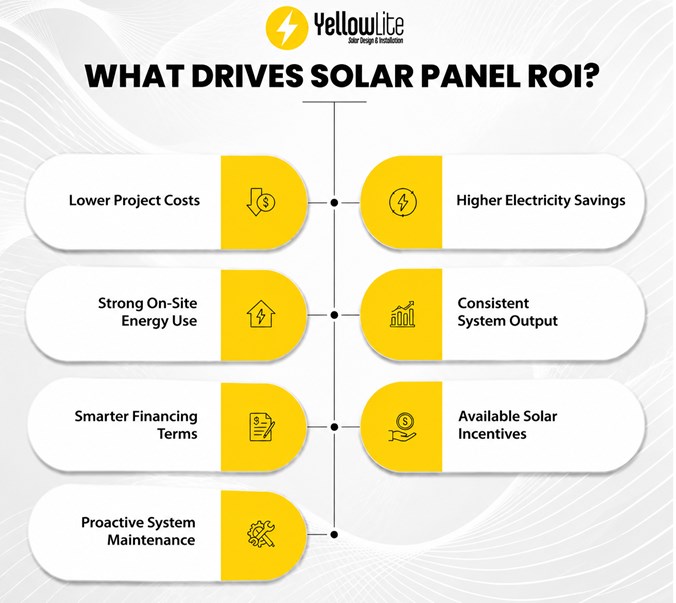
Several financial and operational factors determine whether a solar project delivers the return a business expects.
|
ROI Factor |
How It Affects the Return |
|
Project cost |
Sets the capital that must be recovered |
|
Electricity rates |
Higher avoided utility costs can increase savings |
|
On-site energy use |
Direct use of solar generation can improve value |
|
System production |
Strong output supports lifetime savings |
|
Financing |
Rates and terms affect cost and cash flow |
|
Incentives |
Eligible programs can reduce net project cost |
|
Maintenance |
Timely service helps protect output |
The U.S. Department of Energy notes that solar savings are influenced by electricity prices and project economics, while NREL’s System Advisor Model evaluates measures such as payback period, net present value, and internal rate of return.
What to Look for When Choosing a Commercial Solar Partner
Choosing the right solar partner can directly influence system performance, long-term savings, and solar panel ROI. Instead of focusing only on the lowest quote, businesses should evaluate a few key areas.
1. Proven Commercial Experience
Look for experience with projects similar to your facility, whether that is a warehouse, manufacturing plant, office, or large commercial property. A proven track record helps show that the provider understands the energy and operational demands of larger systems.
YellowLite, for example, brings commercial solar experience across Ohio and the Midwest, helping businesses plan systems around their actual energy requirements.
2. Strong Engineering and System Design
A well-designed system should consider roof conditions, shading, electrical infrastructure, operating hours, and energy consumption. Accurate modelling helps ensure the system is appropriately sized and supports stronger solar panel ROI over time.
3. End-to-End Project Support
Permitting, utility interconnection, installation, commissioning, monitoring, and maintenance all affect project performance. Choosing a partner that manages these stages together can reduce delays and simplify long-term system management.
4. Clear Financial Projections
The proposal should clearly explain expected energy production, projected savings, maintenance costs, payback period, and ROI assumptions. YellowLite uses detailed project assessments to help businesses understand the financial case before moving forward.
5. Quality Equipment and Warranties
Review the panels, inverters, mounting systems, monitoring tools, and warranty coverage being offered. Reliable components and ongoing monitoring help reduce downtime and protect the savings your solar investment is expected to generate.
How Electricity Rates, Incentives, and Financing Affect Solar Panel ROI
Electricity rates, incentives, and financing all shape the financial return of a solar project. As utility rates rise, every kilowatt-hour generated and used on-site can become more valuable by reducing how much energy you draw from the grid..
Incentives may lower the net project cost, while financing determines how quickly the business begins realizing savings. Cash, loans, and third-party financing can each produce different long-term outcomes.
For a realistic solar panel ROI estimate, businesses should consider actual utility bills, demand charges, available incentives, financing costs, and expected lifetime savings rather than looking at system price alone.
How to Protect Solar Panel ROI After Installation
ROI is not fixed when the system is turned on. Actual performance over time determines whether projected savings become real savings.
Businesses can protect their investment by:
- Monitoring solar production regularly
- Investigating unexpected drops in output
- Keeping equipment and warranty records accessible
- Planning for inspections and necessary repairs
- Comparing actual performance with projected production
New equipment, added shifts, or demand changes can also affect how solar generation is used.
Treating solar as a long-term business asset helps protect both system performance and solar panel ROI.
Build the Business Case Around Lifetime Value
A successful solar investment is not defined by the lowest installation price or the largest system. It is defined by how effectively the project turns solar generation into measurable financial value.
Strong solar panel ROI comes from accurate energy analysis, thoughtful system design, realistic production estimates, suitable financing, and dependable long-term performance.
For Ohio businesses, YellowLite combines site assessment, engineering, financial modelling, installation, and ongoing support to build the business case around realistic performance.
Before approving a project, look beyond the headline price. Understand the assumptions, expected savings, and long-term plan behind the numbers. A system designed around your facility’s actual energy needs has a much stronger foundation for delivering value year after year.
Frequently Asked Questions
Q1. What is a good solar panel ROI for a business?
There is no universal percentage that represents a good solar panel ROI for every business. Compare projected returns with your company’s investment criteria, cost of capital, and alternative uses for the money. Payback period, IRR, NPV, and long-term cash flow provide additional context.
Q2. How do you calculate solar panel ROI?
A basic formula is:
Solar Panel ROI = (Total Financial Benefit − Net Project Cost) ÷ Net Project Cost × 100
For a more accurate commercial calculation, include electricity savings, incentives, financing costs, maintenance expenses, system performance, and the timing of future cash flows.
Q3. How long does it take commercial solar panels to pay for themselves?
There is no fixed payback period. Electricity rates, project cost, energy consumption, financing, available incentives, and annual solar production determine how quickly cumulative savings recover the investment. A facility-specific financial model is more reliable than relying on a broad industry average.
Q4. What can reduce solar panel ROI after installation?
Lower-than-expected production, new shading, equipment faults, extended downtime, and unexpected maintenance can reduce solar panel ROI. Changes in operating hours or facility energy use can also affect how much solar electricity is consumed on-site.
Q5. Does battery storage improve solar panel ROI?
It can. Battery storage may create additional financial value when it helps a business manage peak demand, shift electricity usage, or reduce exposure to higher-cost energy periods. Because storage also adds project cost, its financial impact should be modelled separately using the facility’s actual load profile and utility rate structure.