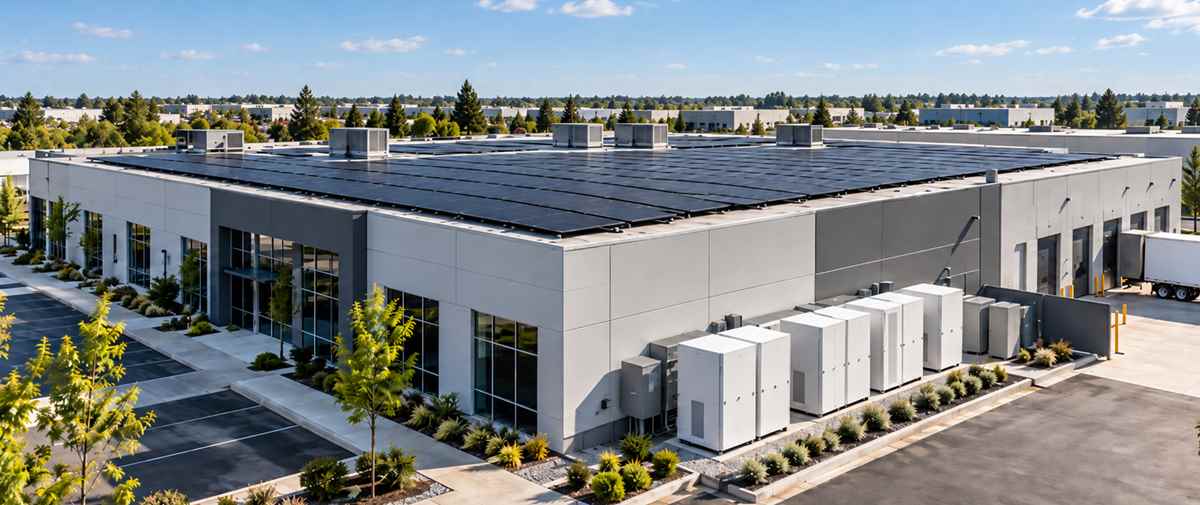



Commercial solar panels can reduce how much electricity a business purchases from the grid. But what happens when solar production and business demand occur at different times?
That is where solar battery storage comes in. Businesses and facilities can use a commercial solar battery to discharge it when the business has a greater financial or operational need. However, adding one does not automatically improve every commercial solar project. Its value depends on your utility rate structure, peak demand, operating schedule, outage exposure, and backup priorities.
This guide explains when storage may be worth considering and what businesses should evaluate before making the additional investment.
Where Solar Battery Storage Creates Business Value
Solar panels generate electricity when sunlight is available. A battery changes when that energy can be used. Instead of sending all unused production to the grid, a business may store available energy for a later period.
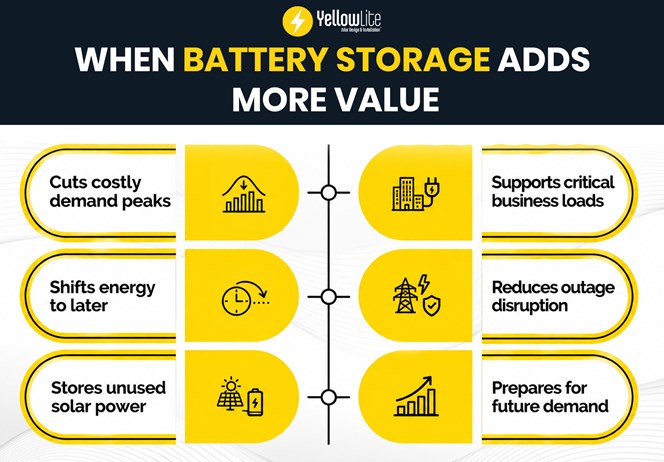
This flexibility can create value in several ways:
- Reducing electricity purchased during expensive periods
- Limiting short spikes in grid demand
- Increasing the on-site use of solar production
- Supporting selected operations during outages
- Improving control over daily energy use
The strongest benefit depends on the business. A warehouse with daytime operations may use most of its solar energy as it is generated, leaving less need for storage. A hotel, grocery store, healthcare office, or manufacturer may have evening loads, critical equipment, refrigeration, or sudden demand peaks that make a commercial solar battery more useful.
Solar energy storage should therefore be designed around a specific job. A battery intended to lower peak demand may require different capacity and controls from one intended to provide several hours of backup power.
The U.S. Department of Energy explains that energy storage can save electricity for use when demand is higher, or solar generation is unavailable. That timing flexibility is what can make storage valuable beyond the energy produced by solar alone.
|
Business Goal |
How Storage May Help |
What Must Be Reviewed |
|
Reduce peak demand |
Discharges during short demand spikes |
Interval usage and utility tariff |
|
Shift energy use |
Saves energy for a higher-cost period |
Time-based electricity rates |
|
Improve solar use |
Holds excess daytime production |
Solar export terms and load timing |
|
Maintain key operations |
Supplies designated critical loads |
Required power and backup duration |
|
Prepare for growth |
Supports changing load patterns |
Planned equipment, EVs, or expansion |
When the Numbers Support a Commercial Solar Battery
The financial case for storage begins with the utility bill, not the battery specification. Two businesses using the same number of kilowatt-hours may receive very different value from storage because their loads and rate structures differ.
A battery may improve project economics when the business:
- Pays meaningful demand charges
- Has sharp, repeatable peaks in electricity use
- Faces higher rates during certain hours
- Receives limited value for exported solar energy
- Uses substantial electricity after solar production declines
- Experiences outage costs that justify backup capability
Demand charges are often based on the highest rate of electricity use recorded during a billing interval. If several machines, HVAC units, refrigeration systems, or EV chargers start together, that brief peak may affect the bill. Properly controlled storage can discharge during the spike and reduce the amount drawn from the grid.
However, the battery must have enough power, measured in kilowatts, to address the peak and enough usable energy, measured in kilowatt-hours, to sustain the discharge. Capacity alone does not reveal whether a system can manage the required load.
Businesses should follow this review before requesting a proposal:
- Collect at least 12 months of utility bills.
- Request interval usage data from the utility.
- Identify when and how often demand peaks occur.
- Compare those peaks with expected solar production.
- List the loads that would require backup power.
- Model battery cycling, degradation, warranties, and replacement assumptions.
- Compare the added project cost with the expected financial and operational value.
A Commercial Solar Feasibility Calculator can provide an initial indication, but the best way to find out how many solar panels you'll need, and how much you can save on your energy costs is to get a detailed solar system design and interval-based financial modeling. Available incentives may also affect project economics, but businesses should confirm current eligibility and tax treatment with qualified financial and tax professionals.
When Backup Power Changes the Decision
For some businesses, storage is less about monthly savings and more about the cost of being without power. Lost production, spoiled inventory, interrupted transactions, uncomfortable tenants, or inactive security and communication systems can turn a short outage into a larger operating loss.
A standard grid-connected solar system normally shuts down when the utility grid fails unless it has equipment designed to operate safely during an outage. Solar paired with properly configured storage can disconnect from the grid and support designated loads. The Department of Energy notes that distributed solar combined with local storage can provide power near the customer when the centralized system is disrupted.
Backup expectations must still be realistic. A battery designed for lighting, internet, security, controls, and selected refrigeration is different from a system expected to run an entire manufacturing plant.
Before choosing backup capacity, determine:
- Which operations are truly critical
- The starting and continuous power of each load
- How many hours the loads must operate
- Whether solar can recharge the battery during an extended outage
- Which equipment can be temporarily switched off
Storage may not be the best addition when outages have little business impact, demand charges are minimal, solar already matches daytime consumption, or the projected benefit does not justify the cost. In that situation, investing first in commercial solar, efficiency improvements, or load scheduling may provide greater value.
Key Takeaways
Solar battery storage improves the value of commercial solar when it solves a measurable problem. That problem may be costly demand peaks, time-based electricity rates, unused daytime generation, or the need to keep essential operations running during an outage.
The right decision requires more than selecting a battery by capacity. YellowLite evaluates the property, shade, location, interval electricity use, expected annual production, utility rate structure, critical loads, and future energy plans. It then models how solar and storage would work together before installation planning begins. For businesses with the right load profile and priorities, storage can turn solar from an energy-producing asset into a more flexible energy strategy.

FAQs
Q1. Can I lease solar battery storage systems for my business?
Financing and lease options depend on the project, battery system, and provider. YellowLite can review available ownership and financing routes for your business.
Q2. How much does a business solar battery installation cost?
Cost depends on battery capacity, power requirements, backup duration, site conditions, electrical upgrades, and installation complexity. A site-specific assessment provides the clearest estimate.
Q3. What are the benefits of commercial solar battery systems?
They can store available solar energy, reduce peak grid demand, support critical loads during outages, and give businesses greater control over energy use.
Q4. What are the best battery storage solutions for small businesses?
The best solution is one sized around the business’s load profile, operating hours, utility rate structure, available space, and backup priorities.
Q5. Can a commercial solar battery power my entire business during an outage?
It can, but whole-building backup may require substantial capacity. Many businesses prioritize refrigeration, lighting, security, servers, and other critical loads instead.
Q6. How do I know if solar battery storage is worth it for my business?
Review your demand charges, interval usage, outage costs, operating schedule, and unused solar production. YellowLite can model these factors before recommending storage.