
Choosing the right inverter is an important part of designing a solar energy system. While solar panels generate electricity from sunlight, an inverter converts that electricity into a form that household appliances and commercial equipment can use.
Among the available inverter technologies, solar microinverters have become a popular option for residential rooftop installations. They offer panel-level electricity conversion, individual performance monitoring, and greater flexibility for roofs with shading or roof.
Unlike traditional string inverter systems, where multiple solar panels connect to a central inverter, microinverters operate independently at individual solar panels.
This design can help improve energy production, simplify system monitoring, and reduce the impact of individual panel failures.
However, microinverters also have limitations, including higher upfront costs and potentially more complicated maintenance.
So, what are solar microinverters, how do they work, and are they worth the additional investment? Let's explore their technology, benefits, costs, and suitability for residential and commercial solar installations.
1. What Is a Solar Microinverter?
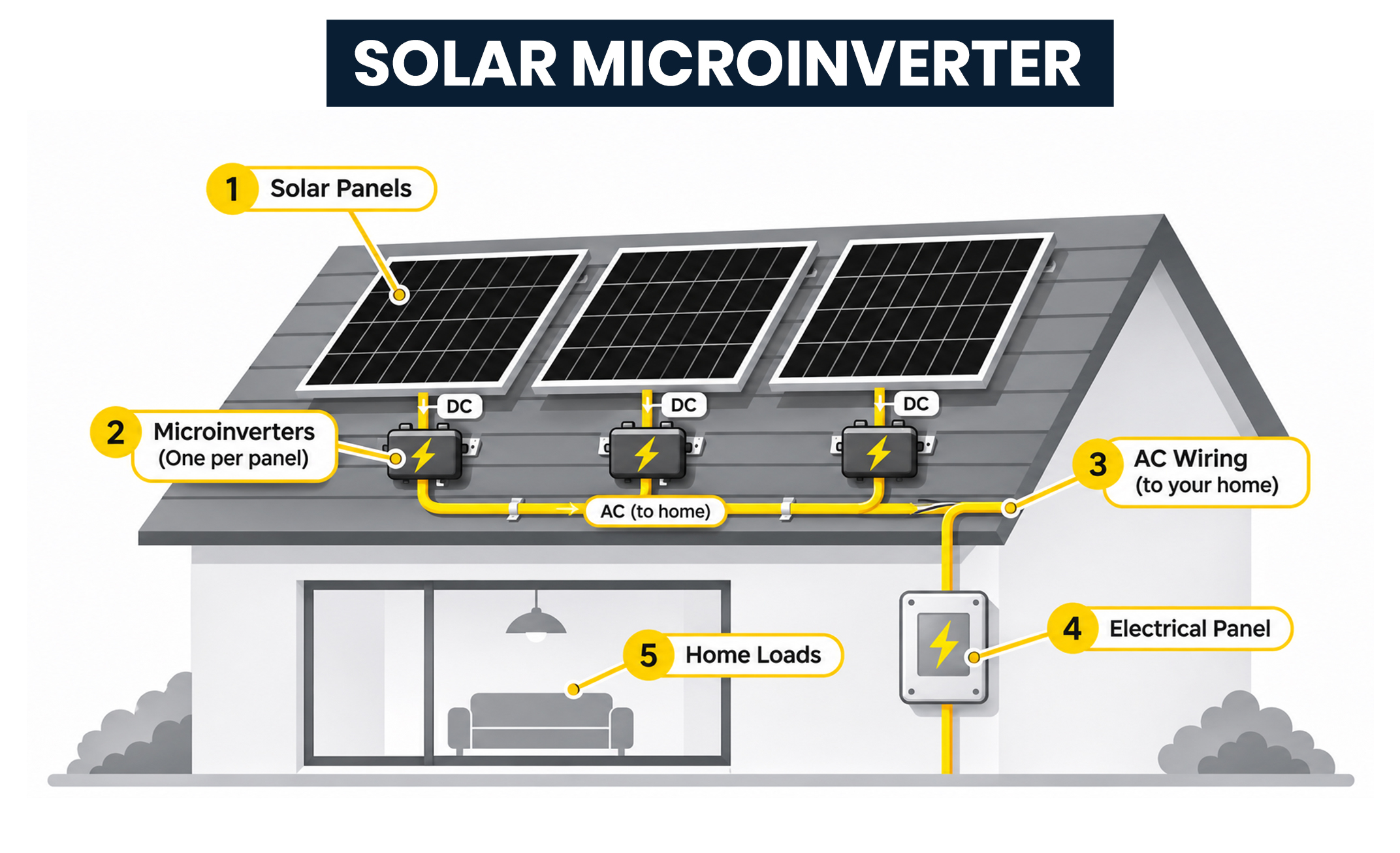
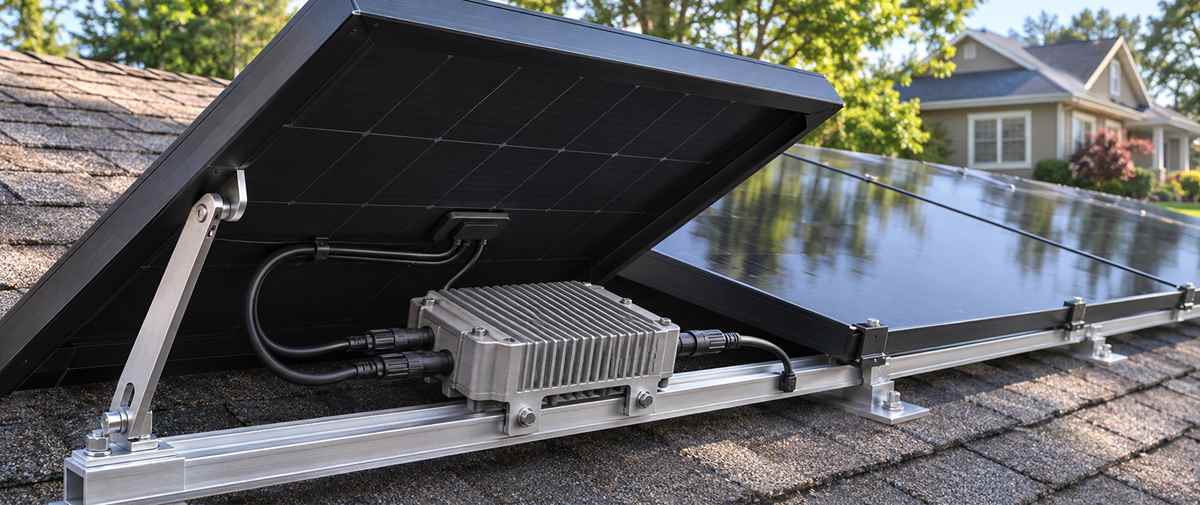
A solar microinverter is a small electronic device installed underneath or near an individual solar panel. Its primary function is to convert the direct current (DC) electricity generated by that panel into alternating current (AC) electricity which can then be used inside the home.
Most residential microinverter systems use one microinverter for each solar panel. Some designs can connect multiple panels to a single microinverter, depending on the manufacturer's specifications.
Traditional solar systems often use a central string inverter to convert electricity generated by multiple connected panels. Microinverters distribute this conversion process across the entire solar array.
This allows each solar panel to operate independently rather than depending on the performance of other panels in the same string.
Why are microinverters used in solar installations?
Microinverters are particularly useful for properties where solar panels experience different sunlight conditions.
For example, a house may have solar panels installed across two or three roof sections. Some panels may receive direct sunlight throughout the day, while others experience shading from trees, chimneys, or nearby buildings.
With microinverters, each panel can optimize its own electricity production instead of relying on the output of the entire string.
This makes microinverters an attractive option for residential rooftop solar systems and certain commercial installations.
2. How Do Solar Microinverters Work?
Solar microinverters work by converting DC electricity into AC electricity directly at the individual solar panel level.
Unlike traditional string inverter systems, they do not require all solar panels to depend on one central inverter for power conversion.
Here is how the process works.
Panel-Level Conversion
Each solar panel generates DC electricity when sunlight reaches its photovoltaic cells.
A microinverter connected to the panel converts this DC electricity into AC electricity suitable for the property's electrical system.
In a typical residential installation, every panel has its own microinverter. The resulting AC electricity travels through the system's AC wiring to the electrical panel, where it can supply household appliances.
This distributed design reduces the need for long, high-voltage DC cable runs across the roof.
Independent Maximum Power Point Tracking (MPPT)
Maximum Power Point Tracking (MPPT) is a technology that helps solar panels generate as much usable electricity as possible under changing environmental conditions.
Solar panel output changes depending on sunlight intensity, temperature, shading, and other factors.
Microinverters use independent MPPT to optimize the electricity production of each connected panel separately.
For example, imagine a solar installation with ten panels. Five panels receive direct sunlight, while the remaining five experience partial shading.
With microinverters, each panel can operate at its own optimal power point. Reduced production from shaded panels does not directly limit the output of the other panels.
Shade and Debris Tolerance
Shading is a common challenge for residential solar installations.
Trees, chimneys, nearby buildings, dust, and bird droppings can reduce the amount of sunlight reaching individual panels.
In conventional string inverter systems, shading on one panel can affect the performance of other panels in the same electrical string.
Microinverters help reduce this problem because each panel operates independently.
If one panel becomes shaded or dirty, the remaining panels continue generating electricity based on their own sunlight conditions.
However, microinverters cannot eliminate the electricity loss experienced by the shaded or dirty panel itself.
3. Microinverters vs. String Inverters: What Is the Difference?
Microinverters and string inverters are two common technologies used in grid-connected solar installations.
Both convert DC electricity generated by solar panels into AC electricity. The main difference is where this conversion takes place.
A string inverter is usually installed near the property's electrical equipment and handles electricity from multiple connected solar panels.
A microinverter performs the conversion at the individual solar panel level.
|
Comparison Factor |
Microinverter |
String Inverter |
|
Installation |
Connected to individual panels |
Central inverter handles multiple panels |
|
Electricity Conversion |
Panel-level DC-to-AC conversion |
Central DC-to-AC conversion |
|
Shading Impact |
Limits the effect of shading on other panels |
Shading can affect production across a string |
|
Panel Monitoring |
Individual panel monitoring available |
Usually string-level monitoring |
|
Initial Cost |
Generally higher |
Generally lower |
|
System Expansion |
Often more flexible |
May require inverter capacity and string redesign |
|
Maintenance |
Faulty units may require roof access |
Central inverter is generally easier to access |
|
Failure Impact |
One failed microinverter usually affects its connected panel |
A failed central inverter can stop the connected array |
|
Warranty |
Some models offer up to 25 years |
Commonly shorter, depending on model and extended coverage |
Which inverter is better for solar panels?
YellowLite's solar experts can make recommendations on which inverter works best for your solar project.
4. Key Benefits of Microinverters for Solar Panels
Microinverters offer several advantages over conventional inverter configurations. Their main benefit is the ability to manage solar production independently at each panel.
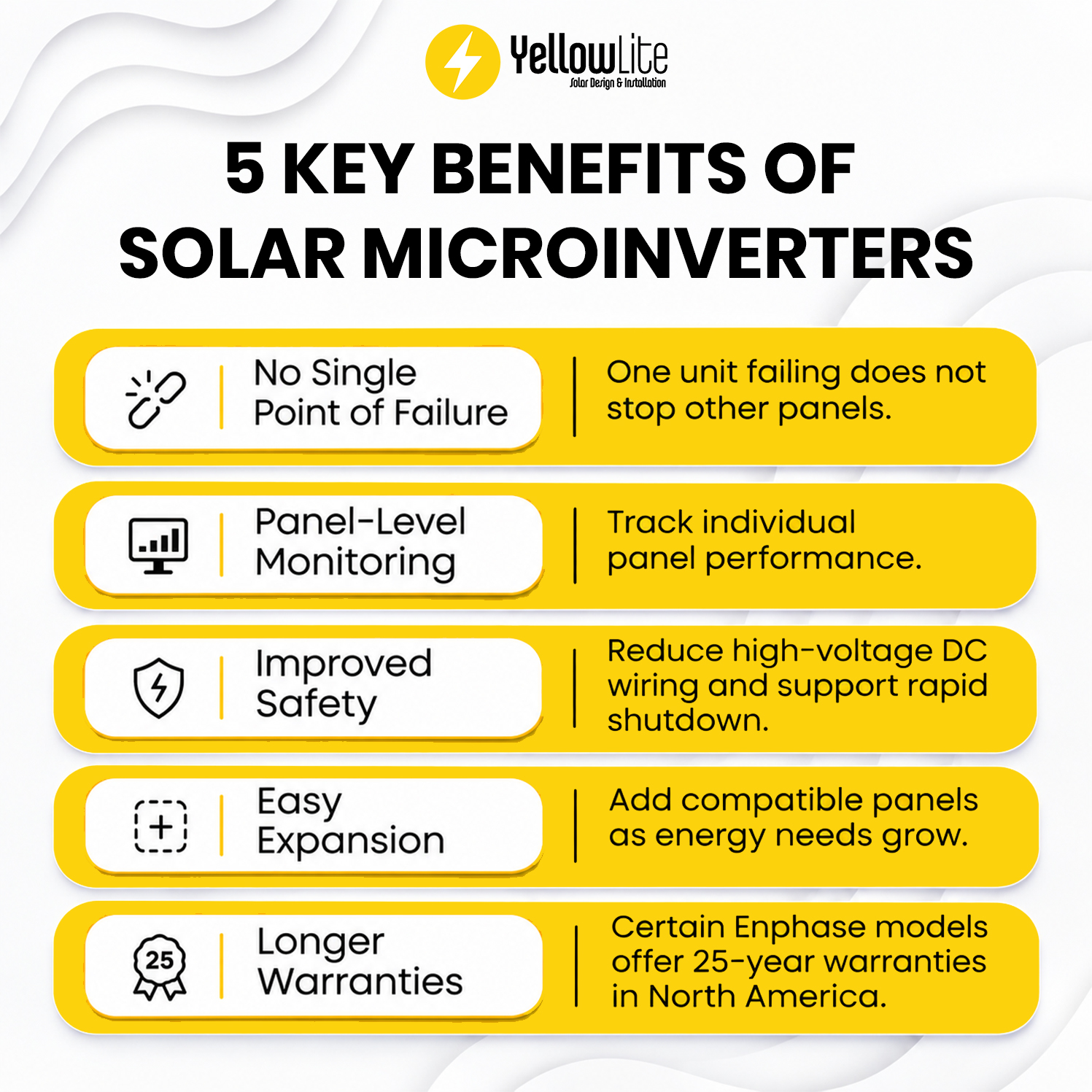
No Single Point of Failure
One of the biggest advantages of microinverters is that the entire solar installation does not depend on a single central inverter.
If one microinverter stops working, the remaining microinverters can continue converting electricity from their connected panels.
For example, consider a residential solar system with 15 panels and 15 microinverters.
If one microinverter fails, the other 14 units can continue operating normally, provided the AC wiring, grid connection, and other system components remain operational.
This reduces the impact of an individual inverter failure on overall electricity production.
Real-Time Panel-Level Monitoring
Microinverter technology allows homeowners and businesses to monitor the performance of individual solar panels.
Many manufacturers provide mobile applications or monitoring platforms that display electricity generation and system health information.
For example, Enphase provides an energy monitoring platform that allows users to view solar production through its app.
With panel-level monitoring, system owners can:
- Check the electricity generation of individual panels.
- Identify underperforming solar panels.
- Detect inverter communication or production issues.
- Review historical energy generation.
- Monitor system performance over time.
This information can help installers identify problems more quickly and determine whether a panel or microinverter requires attention.
Improved Electrical Safety
Traditional string inverter systems use DC wiring to transport electricity from multiple solar panels to a central inverter.
Depending on system design, these cables can carry relatively high DC voltages across rooftop areas.
Microinverters convert DC electricity into AC electricity at the panel level. This reduces the need for long, high-voltage DC cable runs across the roof.
The resulting AC-based architecture can reduce certain electrical hazards associated with high-voltage rooftop DC wiring.
Microinverters also commonly provide rapid shutdown functionality, helping installations meet applicable electrical safety requirements.
However, they do not eliminate all electrical hazards. Correct wiring, grounding, overcurrent protection, certified equipment, and professional installation remain essential.
Easy Solar System Expansion
Microinverters can make it easier to expand an existing solar installation.
With a traditional string inverter, adding solar panels may require checking the inverter's remaining capacity, string voltage limits, current limits, and electrical configuration.
With a microinverter system, additional compatible panels and microinverters can often be added without replacing a large central inverter.
This can be useful for homeowners who plan to increase their electricity consumption in the future.
For example, a homeowner may initially install a 6 kW solar system and later add panels to support an electric vehicle charger or increased household energy demand.
However, system expansion is not automatically plug-and-play. Installers must check electrical capacity, equipment compatibility, utility approval, and applicable installation requirements.
Longer Product Warranties
Microinverters often have longer product warranties than conventional string inverters.
For example, Enphase offers a 25-year limited warranty on its IQ8 and IQ9 microinverter products in North America.
However, warranty coverage varies by manufacturer, model, market, and installation conditions.
Buyers should compare product warranty duration, replacement coverage, labor reimbursement, and shipping expenses before selecting an inverter.
5. What Are the Drawbacks of Microinverters?
Although microinverters offer several advantages, they are not the best solution for every solar installation.
Their higher initial cost and roof-mounted electronics are important considerations.
Higher Initial Installation Cost
Microinverters generally cost more than traditional string inverter systems because the installation requires multiple inverter units instead of one central inverter.
Some project estimates place microinverter systems approximately 30%–50% higher in upfront cost than comparable string inverter configurations. However, this is not a universal premium and should not be applied to the entire installed project without reviewing actual quotes.
The price difference depends on inverter models, system capacity, installation complexity, monitoring equipment, and labor.
More Difficult Maintenance Access
Microinverters are typically installed underneath solar panels on the roof.
If an individual unit fails, a technician may need to access the roof, remove or lift the affected panel, and replace the faulty component.
This can increase repair labor costs compared with replacing a centrally located string inverter.
However, panel-level monitoring can help installers identify the location of the problem before carrying out repairs.
Individual Unit Replacement
A microinverter system contains multiple electronic devices.
Although one unit failing does not normally stop the entire installation, individual units may eventually require replacement.
Homeowners should understand the manufacturer's warranty terms and whether replacement labor is included.
6. Can Microinverters Improve Solar Panel Performance?
Yes. Microinverters can improve overall solar energy production under certain conditions.
Their main advantage is that they allow individual panels to operate independently.
In a string inverter system, the performance of connected panels can be affected by the output of the weakest-performing panel, depending on the system configuration and the presence of bypass diodes or power optimizers.
Microinverters reduce this mismatch issue by allowing independent panel-level power conversion and MPPT.
This can be particularly useful for installations with:
- Partial shading from nearby trees or buildings.
- Different roof orientations.
- Multiple roof slopes.
- Panels installed at different angles.
- Varying sunlight exposure throughout the day.
However, microinverters do not automatically increase electricity generation in every solar installation.
A well-designed string inverter system on an unshaded roof may perform similarly while costing less.
The actual improvement depends on the property's shading conditions, panel layout, inverter specifications, and system design.
7. What Happens If One Solar Panel or Microinverter Stops Working?
A solar microinverter system is designed to reduce the impact of individual equipment failures.
If one microinverter stops working, the solar panel connected to that inverter generally stops delivering electricity to the AC system.
However, the other panels and microinverters can continue generating power.
This is different from a conventional string inverter system, where a central inverter failure can stop electricity conversion for the entire connected array.
Panel-level monitoring can also help identify which unit has stopped reporting or producing electricity.
Homeowners should contact their installer when an inverter failure is detected rather than attempting rooftop electrical repairs themselves.
8. Are Microinverters Suitable for Residential Rooftop Solar Systems?
Yes. Microinverters are widely used in residential rooftop solar installations, particularly where homeowners want individual panel monitoring and flexible system design.
They can be especially useful for homes with complex rooftops.
For example, a property may have solar panels installed on south-facing and west-facing roof sections.
These panels receive different levels of sunlight throughout the day. With microinverters, each panel can optimize its electricity production independently.
Microinverters are also suitable for homes with:
- Partial shading.
- Multiple roof orientations.
- Different roof slopes.
- Limited space for a central inverter.
- Plans for future solar expansion.
For a simple, unshaded roof with all panels facing the same direction, a string inverter may offer a more economical solution.
9. Are Microinverters Suitable for Commercial Solar Installations?
Yes. Microinverters are not limited to residential solar installations. Commercial microinverter products are available for suitable three-phase solar systems.
Businesses with multiple roof sections, shading challenges, or complicated building layouts may benefit from the distributed inverter architecture.
For example, offices, retail buildings, schools, warehouses, and small industrial facilities may have different rooftop areas with varying sunlight conditions.
Microinverters can provide panel-level monitoring and reduce the impact of individual inverter failures.
Commercial manufacturers have also introduced dedicated three-phase microinverter products for larger projects.
For example, Enphase's IQ9N-3P commercial microinverter is designed for three-phase 480Y/277 V applications and supports systems ranging from under 100 kW to several hundred kilowatts, depending on project design.
However, large commercial facilities should compare microinverter and string inverter solutions based on:
- Total system capacity
- Installation and equipment costs
- Electrical infrastructure
- Maintenance requirements
- Energy production
- Monitoring requirements
- Future expansion plans
For large, uniform rooftop or ground-mounted installations, string inverter systems may offer better project economics.
10. How Much Do Solar Microinverters Cost?
Microinverter pricing depends on the model, power rating, manufacturer, and number of solar panels in the installation.
A typical microinverter system has a higher equipment cost than a traditional string inverter system because every solar panel requires its own power conversion unit in most configurations.
The actual cost of a solar installation also includes panels, mounting equipment, electrical wiring, labor, permitting, and other project expenses.
The U.S. Department of Energy tracks residential and commercial solar installation costs through its national PV system cost benchmarks.
What affects the total cost of a microinverter system?
Several factors influence the final installation price:
- Number of solar panels: More panels generally mean more microinverter units.
- Inverter capacity: Higher-output microinverters may cost more.
- Roof complexity: Difficult roof access, multiple orientations, and complex layouts can increase labor expenses.
- Monitoring equipment: Gateways and communication devices may add to the total cost.
- Installation labor: Electrical work, mounting, and commissioning affect the overall investment.
- Warranty coverage: Longer warranty periods and additional service coverage may influence product pricing.
Before choosing a system, request comparable proposals from installers. Make sure the quotes include the same solar panel capacity, inverter specifications, monitoring features, warranty coverage, and installation requirements.
11. What Warranty Should You Consider When Buying Microinverters?
Warranty coverage is an important factor because solar systems are designed to operate for many years.
Many conventional string inverters have shorter standard warranties, while some microinverter manufacturers offer warranties extending to 25 years.
For example, Enphase provides a 25-year limited warranty for its IQ8 and IQ9 microinverters in North America.
However, a long product warranty does not always mean that all replacement and maintenance expenses are covered.
Before purchasing, check:
- Product warranty duration
- Coverage for manufacturing defects
- Replacement equipment costs
- Shipping and labor coverage
- Warranty transferability
- Conditions related to installation and registration
- Whether the warranty applies to the specific product in the United States
Also check the warranty offered by other manufacturers on the exact model being considered. Do not assume that every model or regional version has the same warranty period.
12. How to Choose the Right Solar Microinverter for Your Property
Selecting the right microinverter requires more than comparing product prices.
Homeowners and businesses should evaluate system requirements and roof conditions before making a purchasing decision.
Consider your roof design.
If your roof has multiple slopes, different orientations, or partial shading, microinverters may provide useful performance advantages.
Check inverter compatibility.
The microinverter must be compatible with your selected solar panels. Check maximum input voltage, operating current, power ratings, and approved panel combinations.
Compare efficiency ratings.
Look at CEC-weighted efficiency rather than relying only on peak efficiency. This gives buyers a more useful performance comparison under standardized testing conditions.
Evaluate monitoring features.
Panel-level monitoring can help detect performance issues and improve system visibility.
Check whether monitoring requires additional gateways, subscriptions, or communication equipment.
Review warranty and installer support.
Choose products with clearly documented warranties and accessible service support in your area.
The availability of qualified installers and replacement parts can be just as important as the warranty duration.
Compare the total installation cost.
Microinverters may have a higher initial price, but their flexibility, monitoring, and performance advantages may provide additional value under suitable installation conditions.
A professional installer can compare the expected energy production and lifetime costs of microinverter and string inverter configurations for your property.
Frequently Asked Questions (FAQs)
1. What is a solar microinverter?
A solar microinverter is a small device installed underneath or near an individual solar panel. It converts the DC electricity generated by the panel into AC electricity that household appliances and commercial equipment can use.
2. How does a microinverter differ from a traditional inverter?
A traditional string inverter converts electricity generated by multiple connected solar panels through a central device. A microinverter performs DC-to-AC conversion at the individual solar panel level, allowing each panel to operate independently.
3. Can microinverters improve solar panel efficiency?
Microinverters can improve overall system energy production under certain conditions by reducing panel mismatch losses and minimizing the effects of shading. However, they do not automatically make solar panels themselves more efficient.
4. Do microinverters work better with shaded solar panels?
Microinverters can reduce the impact of shading on the other panels in an installation because each panel operates independently. However, a shaded panel will still generate less electricity than it would under direct sunlight.
5. Can I monitor each solar panel with microinverters?
Yes. Many microinverter systems provide panel-level monitoring through mobile applications or online platforms. Homeowners can check individual panel performance, electricity production, and certain equipment alerts.
6. What happens if one microinverter fails?
If one microinverter fails, the panel connected to it generally stops producing usable AC electricity. The remaining microinverters can continue operating normally, provided the rest of the system is functioning correctly.
7. Are microinverters better than string inverters?
Microinverters are often better suited to complex roofs and installations with partial shading. String inverters are generally more economical for simple, unshaded installations. The best option depends on roof design, budget, and electricity requirements.
8. How long do solar microinverters last?
Microinverters are designed for long-term operation, and certain products carry warranties of up to 25 years. Actual service life depends on product quality, installation conditions, operating temperature, and maintenance.
9. Are microinverters suitable for commercial solar systems?
Yes. Manufacturers offer commercial microinverters designed for three-phase electrical systems. They can be useful for commercial properties with complex rooftops and panel-level monitoring requirements. System size, equipment compatibility, and project economics should be evaluated before installation.
10. Can I add more solar panels to an existing microinverter system?
In many cases, yes. Microinverter systems can offer flexibility for future expansion. However, the installer must check electrical capacity, inverter compatibility, mounting requirements, and utility approval before adding more panels.
Conclusion
Solar microinverters offer an alternative to traditional string inverter technology by converting electricity at the individual solar panel level.
Their main advantages include independent panel operation, improved shading tolerance, individual performance monitoring, flexible installation layouts, and reduced dependence on a single central inverter.
These features make microinverters particularly useful for residential properties with complex roofs and certain commercial solar installations.
However, their higher initial costs and roof-mounted electronics can make maintenance more complicated.
For properties with simple, unshaded rooftops, traditional string inverters may provide a more affordable solution. For installations with shading, multiple roof orientations, or a need for panel-level monitoring, microinverters may justify the additional investment.
The best choice depends on the property's solar potential, electricity requirements, installation budget, and long-term energy goals.
Find out which solar inverter will work best for your solar project. Speak with one of YellowLite's solar experts today.