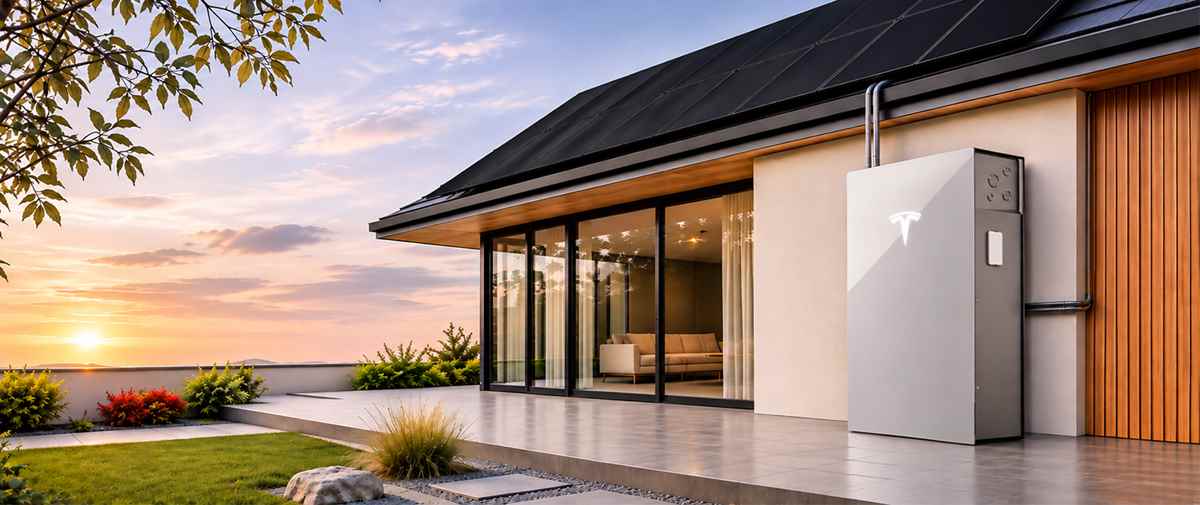


Solar batteries store excess electricity generated during the day for use at night, during cloudy weather, or power outages. While lithium-ion batteries currently dominate solar energy storage, sodium-ion batteries are emerging as a promising alternative because they use widely available sodium instead of lithium.
They offer potential cost advantages, better cold-weather performance, and reduced dependence on certain critical minerals. However, lower energy density and developing manufacturing supply chains remain challenges.
According to the International Energy Agency (IEA), the latest sodium-ion cells can reach up to 175 Wh/kg, compared with 205 Wh/kg for lithium iron phosphate (LFP) and 265 Wh/kg for nickel manganese cobalt oxide (NMC) batteries.
So, can sodium-ion technology become a practical alternative for residential and commercial solar storage? Let's explore its benefits, limitations, and future potential.
1. What Is a Sodium-Ion Battery?
A sodium-ion battery is a rechargeable battery that stores and releases electricity by moving sodium ions between its positive and negative electrodes.
It works on a principle similar to lithium-ion battery technology. The main difference is the material used to transfer electrical charge. Lithium-ion batteries use lithium ions, while sodium-ion batteries use sodium ions.
Sodium-ion batteries are also known as Na-ion batteries or Na+ batteries. They are sometimes referred to as salt batteries because sodium is commonly associated with salt. However, the term salt battery can also describe other battery technologies, including sodium-sulfur batteries.
The technology uses four main components:
- Cathode: The positive electrode that stores sodium ions when the battery is discharged.
- Anode: The negative electrode that stores sodium ions when the battery is charged.
- Electrolyte: The medium that allows sodium ions to move between the electrodes.
- Separator: A protective layer that prevents the electrodes from coming into direct contact.
One reason sodium-ion batteries are attracting attention is the availability of their primary raw material. Sodium is much more abundant and widely distributed than lithium, potentially making it easier to develop alternative battery supply chains.
These characteristics make sodium-ion technology interesting for renewable energy storage, electric vehicles, and large-scale electricity storage.
2. How Does Sodium-Ion Battery Technology Work?
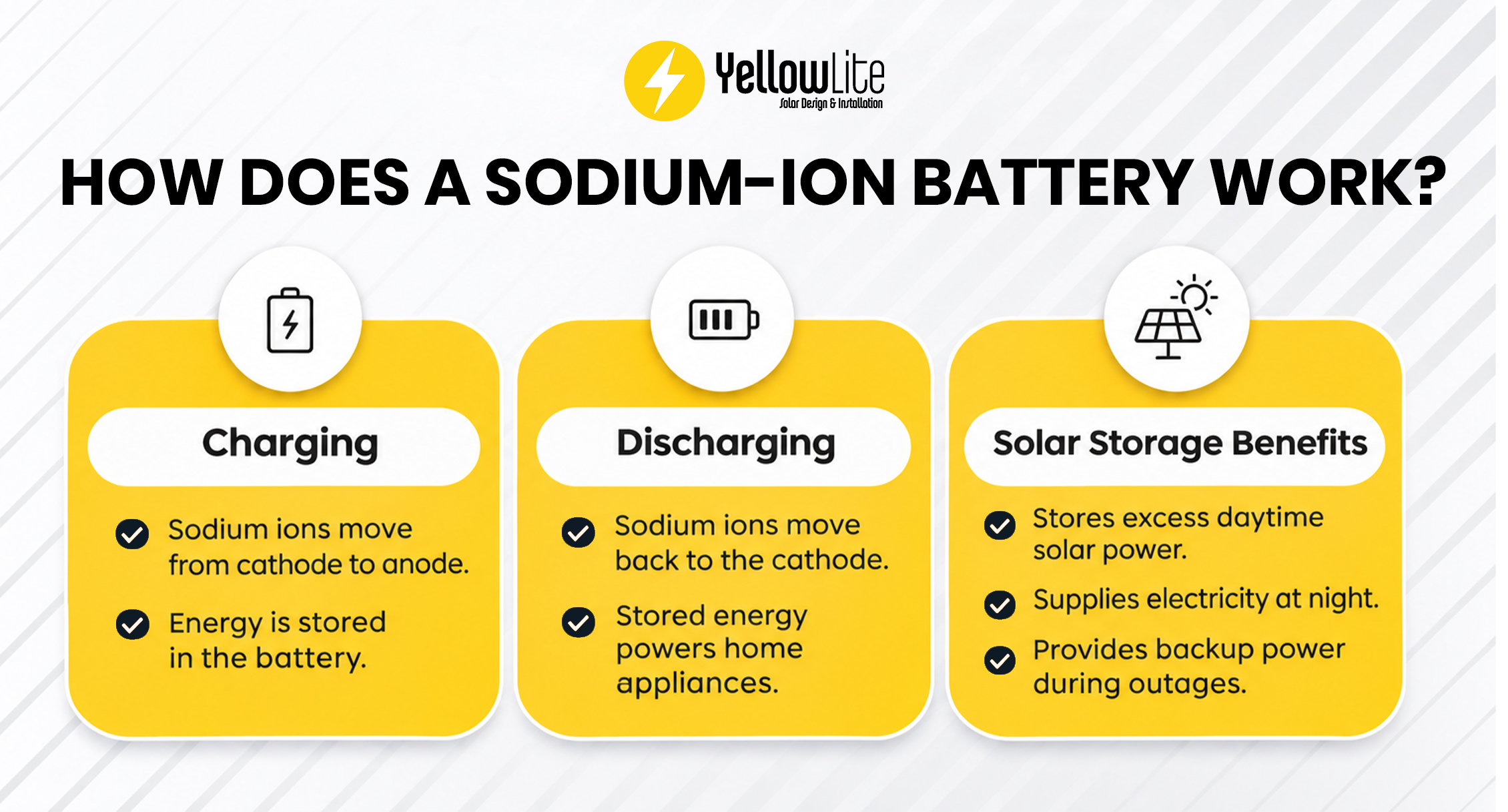
Sodium-ion battery technology works through a process called ion movement or intercalation. During charging and discharging, sodium ions travel between the two electrodes through the electrolyte.
The battery completes two main processes.
During charging:
- Solar panels generate electricity and send it to the battery through a compatible charge controller or inverter.
- Electrical energy drives sodium ions from the cathode towards the anode.
- Sodium ions enter and become stored within the anode material.
- The battery stores this energy for later use.
During discharging:
- When electricity is required, sodium ions move from the anode towards the cathode.
- Electrons travel through the external electrical circuit.
- This movement generates an electric current.
- The stored electricity can power household appliances, lighting, and other connected equipment.
For a solar energy system, this process allows excess daytime electricity to be stored rather than sent back to the grid or wasted.
Explore YellowLite's solar energy storage solutions to understand how homeowners can store excess solar electricity and use it when needed
Homeowners can then use the stored electricity during the evening, at night, or during a power outage, depending on their system configuration.
3. How Do Sodium-Ion, NMC, and LFP Batteries Compare?
Not all lithium-ion batteries use the same chemistry. Three important battery technologies in the energy storage market are sodium-ion, lithium nickel manganese cobalt oxide (NMC), and lithium iron phosphate (LFP).
Each technology offers different advantages depending on energy density, cost, safety, lifespan, and application.
|
Comparison factor |
Sodium-ion |
NMC |
LFP |
|
Main materials |
Sodium-based materials |
Nickel, manganese and cobalt |
Lithium, iron and phosphate |
|
Energy density |
Lower to moderate |
High |
Moderate |
|
Raw material availability |
High sodium availability |
Depends on lithium, nickel and cobalt supply |
Depends on lithium supply |
|
Safety |
Potential advantages depending on chemistry |
Requires careful thermal management |
Generally strong thermal stability |
|
Cold-temperature performance |
Generally good |
Chemistry-dependent |
Can be more limited |
|
Cost potential |
Promising |
Generally more expensive than LFP |
Generally cost-effective |
|
Commercial maturity |
Emerging |
Established |
Well established |
The International Energy Agency reports that the latest sodium-ion cells can reach up to 175 Wh/kg, compared with up to 205 Wh/kg for LFP and 265 Wh/kg for NMC cells. These are upper-end cell-level figures rather than guaranteed specifications for every commercial battery.
Which battery is better for solar energy storage?
LFP batteries are currently a strong choice for residential solar installations because of their established performance, safety characteristics, and commercial availability.
NMC batteries are useful where higher energy density and compact battery designs are important.
Sodium-ion batteries could become an attractive alternative where cold-weather performance, material availability, and long-term operating costs are major considerations.
The best option depends on the homeowner's energy requirements, budget, available products, and installation conditions.
4. Are Sodium-Ion Batteries Suitable for Home Solar Systems?
Yes. Sodium-ion batteries can be used for home solar systems, and residential products have started entering the market.
They can store excess electricity generated by rooftop solar panels and supply power when solar production is low.
For example, a homeowner with a 10 kW solar panel system may generate more electricity than the property needs during sunny afternoons. A compatible sodium-ion battery could store some of that excess energy for evening consumption.
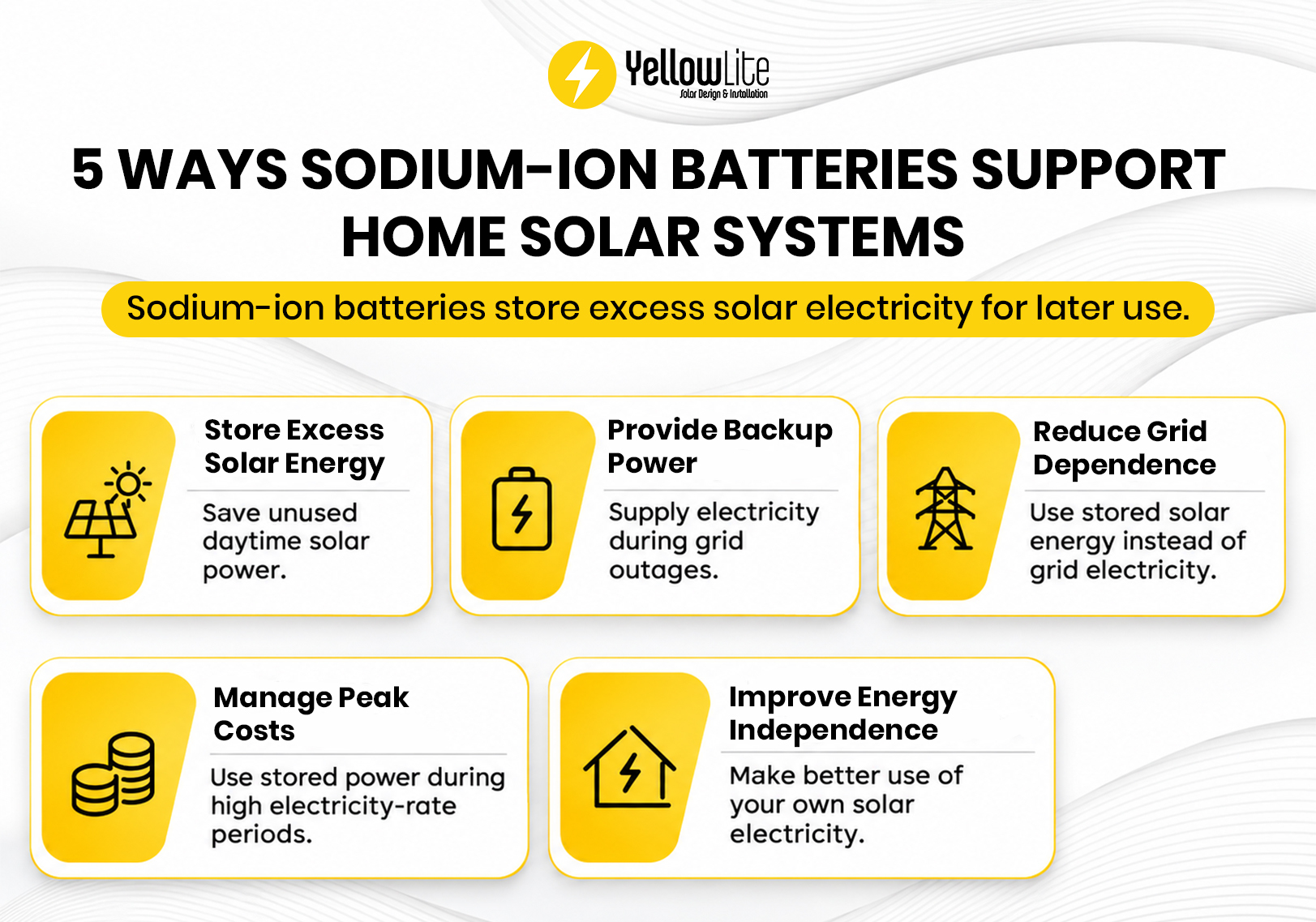
Potential applications include:
- Storing excess solar electricity during the day.
- Providing backup electricity during grid outages.
- Reducing dependence on grid electricity.
- Supporting household energy consumption during peak electricity pricing periods.
- Improving energy independence.
However, homeowners should check whether the battery is compatible with their existing inverter, electrical system, and solar installation.
Battery capacity, charging power, discharge power, warranty, certification, and installer support are also important considerations.
Currently, LFP batteries remain a more established option for most residential solar installations, while sodium-ion products are gradually entering the home energy storage market.
5. How Much Does a Sodium-Ion Solar Battery Cost?
The cost of a sodium-ion battery depends on its storage capacity, battery chemistry, manufacturing scale, and system design.
One of the biggest attractions of sodium-ion technology is its potential to reduce battery production costs. Sodium is widely available and generally less expensive as a raw material than lithium.
However, sodium-ion batteries are still developing commercially, and their manufacturing costs have not yet become consistently lower than those of established lithium-ion batteries.
According to Wood Mackenzie's 2025 market estimate:
|
Battery technology |
Average battery cost benchmark |
|
LFP |
$52 per kWh |
|
Sodium-ion |
$59 per kWh |
These figures are industry-level battery cost benchmarks, not retail prices or complete residential installation costs.
What determines the price of a sodium-ion solar battery?
Several factors influence the final cost:
- Battery capacity: Larger batteries generally require more materials and manufacturing resources.
- Manufacturing scale: Increased production could reduce the cost per kWh.
- Raw materials: Sodium is widely available, potentially reducing dependence on expensive lithium supplies.
- Installation requirements: Inverters, electrical connections, safety equipment, and installation labour affect the overall project cost.
- Battery lifespan: A longer-lasting battery could reduce replacement expenses over its operating life.
As residential sodium-ion products become more widely available, homeowners may have more opportunities to compare prices.
At present, there is no reliable, widely established U.S. retail installation price benchmark for sodium-ion home solar batteries.
6. Are Sodium-Ion Batteries Cheaper Than Lithium-Ion Batteries?
Sodium-ion batteries have the potential to become cheaper than some lithium-ion alternatives, but they are not automatically the more affordable option today.
The main reason is the difference in raw material availability.
Lithium extraction and processing depend on specific geographical resources and concentrated supply chains. Sodium, on the other hand, is available from several natural sources and is distributed across many regions.
Sodium-ion technology can also use more affordable electrode materials, including iron- and manganese-based cathodes in certain designs. Some sodium-ion chemistries also use aluminium current collectors instead of copper, creating additional opportunities for material savings.
However, battery manufacturing costs involve much more than raw materials.
Production equipment, battery quality, cell design, energy density, and manufacturing efficiency all influence the final price.
For example, Wood Mackenzie's 2025 estimates show sodium-ion batteries costing approximately $59/kWh compared with $52/kWh for LFP batteries.
This demonstrates that sodium-ion batteries have cost-reduction potential, but they have not yet achieved a consistent price advantage over LFP.
Why could sodium batteries reduce future energy storage costs?
As production increases, manufacturers may benefit from:
- Lower raw material expenses.
- Reduced dependence on lithium and graphite supply chains.
- Improved manufacturing efficiency.
- Better battery designs and energy density.
- Greater competition between battery manufacturers.
These improvements could make sodium-ion batteries more competitive for residential and commercial solar storage in the coming years.
7. Are Sodium-Ion Batteries Safer Than Lithium-Ion Batteries?
Safety is another important factor when choosing a solar battery for residential or commercial applications.
Some sodium-ion battery designs offer potential safety advantages because of their chemical composition and thermal characteristics.
Certain sodium-ion chemistries can offer better thermal stability than high-nickel lithium-ion batteries. This can help reduce some risks associated with overheating and thermal runaway.
Thermal runaway occurs when a battery cell experiences an uncontrolled rise in temperature, potentially causing fire, gas release, and damage to surrounding cells.
However, it would be incorrect to claim that every sodium-ion battery is safer than every lithium-ion battery.
LFP batteries already offer strong thermal stability, and independent research has shown that some LFP cells have lower thermal hazards than tested sodium-ion cells.
Actual safety depends on several factors:
- Battery chemistry and cell construction.
- Battery management system (BMS).
- Thermal management.
- Overcharge and short-circuit protection.
- Installation quality.
- Product testing and safety certifications.
Therefore, homeowners should evaluate the safety specifications and certifications of an individual battery rather than choosing it based only on its chemistry.
8. Energy Density and Performance: How Much Energy Can Sodium-Ion Batteries Store?
Energy density refers to the amount of energy a battery can store relative to its weight or volume.
It is usually measured in watt-hours per kilogram (Wh/kg) or watt-hours per litre (Wh/L).
Sodium-ion batteries generally have lower energy density than NMC and some LFP batteries. This means they may require more physical space and weight to store the same amount of electricity.
The latest sodium-ion cells can reach approximately 175 Wh/kg, while advanced LFP cells can reach 205 Wh/kg and NMC cells around 265 Wh/kg.
How much electricity can a sodium-ion battery store?
The storage capacity depends on the size and design of the battery system, rather than the battery chemistry alone.
For example, some recently introduced products demonstrate the range of possible applications:
|
Product |
Storage capacity |
Application |
|
Unigrid Na+Casa |
9.25 kWh |
Residential energy storage |
|
Revolta sodium-ion system |
2–20 kWh |
Residential energy storage |
|
CATL TENER Sodium |
More than 30 MWh |
Grid-scale storage |
These products illustrate how sodium-ion technology can serve different storage requirements, from individual homes to large electricity networks. For comparison, widely used residential LFP battery systems like the Tesla Powerwall 3 and FranklinWH offer usable capacities around 13.5 kWh to 13.6 kWh per unit.
What are the performance limitations?
Despite its potential, sodium-ion technology has some limitations:
- Lower energy density can increase battery size and weight.
- Different chemistries have different charging and discharging characteristics.
- The commercial supply chain is less established than lithium-ion.
- Some products may have limited inverter compatibility.
- Long-term performance data is still developing for newer battery products.
For stationary solar storage, these limitations may be less significant than they are for electric vehicles because homeowners and businesses generally have more flexibility regarding battery installation space.
9. Do Sodium-Ion Batteries Work in Extreme Cold or Hot Temperatures?
Temperature performance is one of the most interesting advantages of sodium-ion technology.
Many conventional battery technologies experience reduced performance in extremely cold conditions. Low temperatures can affect charging speed, available capacity, and overall battery efficiency.
Sodium-ion batteries can perform better in cold environments than some lithium-ion alternatives, particularly LFP batteries.
According to the International Energy Agency, the latest sodium-ion technology can retain around 90% of its nominal capacity at temperatures as low as -40°C.
Some next-generation cells are also designed to operate at temperatures as high as 70°C. These figures are based on advanced battery technology and should not be treated as specifications for every commercial product.
Why is this important for solar energy storage?
Better low-temperature performance could make sodium-ion batteries useful for:
- Homes located in colder regions.
- Commercial buildings exposed to seasonal temperature changes.
- Outdoor energy storage installations.
- Remote solar systems.
- Industrial energy storage projects.
However, battery temperature limits vary by manufacturer. Homeowners should always check the specified charging, discharging, and operating temperature ranges before installation.
10. How Long Do Sodium-Ion Batteries Last?
The lifespan of a sodium-ion battery depends on its chemistry, manufacturing quality, operating temperature, charging cycles, and depth of discharge.
Battery lifespan is commonly measured in charge-discharge cycles. One complete cycle represents the equivalent of using 100% of the battery's capacity, even when that happens over multiple partial discharges.
Some recently developed sodium-ion batteries advertise significantly higher cycle-life targets.
For example:
- Unigrid Na+Casa: The manufacturer claims 10,000 full charge-discharge cycles at 100% depth of discharge.
- CATL TENER Sodium: The company reports up to 15,000 cycles at 25°C, with a projected system service life of 25–30 years under its stated operating conditions.
These are manufacturer-reported specifications, not proof that every sodium-ion battery will achieve the same lifespan in everyday residential use.
When comparing solar batteries, homeowners should consider the manufacturer's warranty, guaranteed energy throughput, cycle rating, and expected capacity retention.
A longer lifespan could help reduce battery replacement costs and improve the overall economics of a solar energy system.
11. Why Is Sodium More Abundant Than Lithium? Are Sodium-Ion Batteries More Sustainable?
Sodium is one of the most widely available elements in nature. It can be obtained from seawater, salt deposits, and several mineral resources.
Lithium is comparatively less abundant, and its extraction and processing are concentrated in specific geographical regions.
Wood Mackenzie reports that sodium is approximately 1,000 times more abundant than lithium in the Earth's crust. This availability could help manufacturers diversify battery supply chains and reduce dependence on lithium resources.
Sodium-ion batteries may also offer environmental advantages depending on the chemistry used.
Some sodium-ion designs can reduce dependence on materials such as lithium, cobalt, and graphite. Certain cathode compositions also use more widely available materials, including iron and manganese.
However, sodium-ion batteries are not automatically environmentally friendly.
Their overall environmental impact also depends on:
- Raw material extraction and processing.
- Electricity used during manufacturing.
- Battery transportation.
- Battery lifespan.
- Recycling and end-of-life management.
The technology has the potential to support more diversified and sustainable energy storage supply chains, but better recycling infrastructure and large-scale manufacturing improvements are still required.
12. Are Sodium-Ion Batteries Available for Residential Use?
Yes. Residential sodium-ion batteries have started entering the market, although availability is still limited compared with established lithium-ion products.
One interesting development is Unigrid's Na+Casa residential battery. The 9.25 kWh system has started initial installations in European homes, with U.S. installations expected by the end of 2026, subject to North American compliance requirements.
Another example is Revolta, which introduced a modular residential sodium-ion battery system with capacities ranging from 2 kWh to 20 kWh. The company initially focused on the German market and planned to expand its distribution network.
For homeowners, this means sodium-ion batteries are moving beyond research and development towards commercial applications.
However, before purchasing one, check the following:
- Whether the product is available in your country.
- Whether it has the required safety certifications.
- Whether it is compatible with your solar inverter.
- Whether local installers provide installation and maintenance support.
- Whether the manufacturer offers a clear warranty.
The residential market is developing, but sodium-ion batteries are not yet as widely available as conventional LFP home batteries.
13. Can Sodium-Ion Batteries Be Used for Solar Energy Storage, Homes, and Grid-Scale Energy Storage?
Yes. Sodium-ion batteries can support different energy storage applications, depending on their capacity, power output, and system design.
Residential solar energy storage
Homeowners can use sodium-ion batteries to store excess electricity generated by rooftop solar panels.
The stored electricity can power household appliances, lighting, and other electrical equipment when solar panels are not generating enough electricity.
Commercial solar energy storage
Businesses can use sodium-ion batteries to store electricity generated by commercial solar installations.
This can help manage energy consumption, reduce dependence on grid electricity, and support backup power requirements.
Grid-scale energy storage
Electricity networks need large storage systems to balance electricity supply and demand.
Sodium-ion battery systems can store excess renewable electricity and release it when demand increases.
For example, CATL's TENER Sodium system demonstrates how sodium-ion technology can be configured for large-scale storage projects with storage durations ranging from one to eight hours.
This makes sodium-ion technology relevant to the future of solar energy storage across residential, commercial, and utility-scale applications.
14. Should Homeowners Wait for Sodium-Ion Batteries or Buy Lithium-Ion Batteries?
The decision depends on your current electricity requirements, budget, and willingness to adopt a developing technology.
Sodium-ion batteries offer promising advantages, but LFP batteries remain a more established option for residential solar storage.
Consider buying an LFP battery if:
- You need a solar battery immediately.
- You want an established product with a proven installation network.
- You need clear warranty and after-sales support.
- You prefer a wider selection of compatible solar inverters.
- You want predictable pricing and performance specifications.
Consider waiting for sodium-ion batteries if:
- You are planning a future solar installation rather than purchasing immediately.
- You want to explore alternatives to lithium-based storage.
- Your property experiences extremely cold temperatures.
- You are interested in newer battery technologies.
- You are comfortable evaluating products with a shorter commercial track record.
Our recommendation is not to delay an important solar installation solely to wait for sodium-ion technology. Energy costs are on the rise, and the sooner you can install solar panels, the sooner you will be able to save money on your electric bills.
Instead, compare available LFP batteries with sodium-ion products as they become commercially available. Consider the total ownership cost, usable capacity, warranty, cycle life, and installation requirements.
As manufacturing increases and more residential products become available, sodium-ion batteries could become an important alternative in the home energy storage market.

Conclusion
Sodium-ion batteries have the potential to become an important part of the renewable energy storage industry. Their abundant raw materials, potential cost advantages, and strong low-temperature performance make them an interesting alternative to conventional lithium-ion batteries.
However, the technology still faces challenges related to energy density, manufacturing scale, commercial availability, and long-term performance validation.
For residential solar installations, LFP batteries remain a practical and established choice. Sodium-ion batteries are gradually entering the market, and further improvements could make them increasingly competitive.
Rather than replacing lithium-ion technology completely, sodium-ion batteries are more likely to complement existing battery technologies and provide additional options for residential, commercial, and grid-scale solar energy storage.
Frequently Asked Questions (FAQs)
1. What is the difference between a sodium-ion battery and a salt battery?
A sodium-ion battery is a rechargeable battery that uses sodium ions to store and release electricity. The term salt battery is sometimes used informally to describe sodium-ion technology, but it can also refer to other sodium-based technologies, such as sodium-sulfur batteries.
2. Can sodium-ion batteries charge using solar panels?
Yes. Sodium-ion batteries can store electricity generated by solar panels when connected through a compatible inverter and battery management system. This allows homeowners to use stored electricity when solar generation is low. Learn more about how solar battery storage works and how it helps homeowners use excess solar electricity.
3. Are sodium-ion batteries better than LFP batteries?
Not in every situation. Sodium-ion batteries may offer better low-temperature performance and potential raw material cost advantages. However, LFP batteries currently have a more established supply chain, strong safety characteristics, and wider residential availability.
4. Do sodium-ion batteries contain lithium?
No. Sodium-ion batteries use sodium ions rather than lithium ions to transfer electrical charge. However, the specific materials used in their cathodes, anodes, and electrolytes vary depending on the battery design.
5. Can sodium-ion batteries replace lithium-ion batteries completely?
It is unlikely that sodium-ion batteries will replace every lithium-ion application. Both technologies have different strengths. Sodium-ion batteries could become more popular for stationary energy storage, while lithium-ion batteries may remain preferable where high energy density and compact designs are important.
6. What is the future of sodium-ion batteries in solar energy storage?
The future looks promising as manufacturers increase production, develop residential storage products, and introduce larger grid-scale battery systems. However, manufacturing costs, energy density, product availability, and long-term reliability will determine how quickly the technology becomes mainstream.