Solar energy is becoming more accessible to homeowners and renters across the United States. However, not everyone has a suitable roof, enough space, or the budget required for a traditional rooftop solar installation.
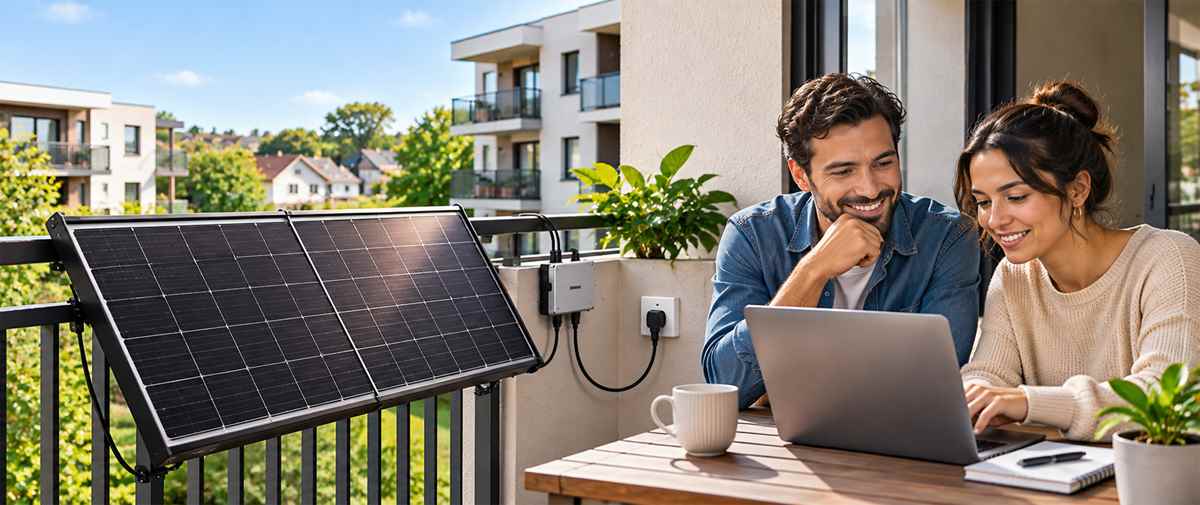
Plug-in solar panels offer another way to generate electricity without installing a large rooftop solar system. Also known as balcony solar or plug-and-play solar, these systems use small solar panels connected to microinverters to supply electricity to a property's electrical circuit.
They are particularly useful for apartment residents, renters, and homeowners who want to explore solar energy with a smaller upfront investment.
But are plug-in solar panels really worth the money? How much can they save on electricity bills? Are they legal in the United States, and what safety requirements should you consider before buying one?
Let's explore how plug-in solar works, its costs, benefits, limitations, and whether it is the right choice for your property.
1. What Are Plug-In Solar Panels?
Plug-in solar panels are small solar panel kits that generate electricity and connect to a property's electrical circuit through a compatible plug and outlet.
Unlike traditional rooftop solar systems, which generally require professional installation and a connection through dedicated electrical equipment, plug-and-play solar systems are designed around simpler installation and smaller power capacities.
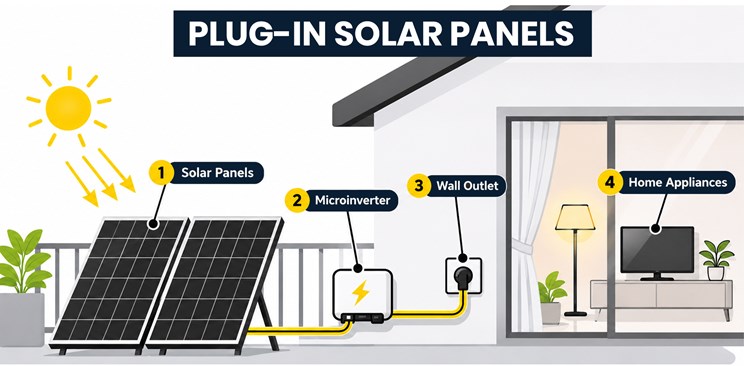
These systems typically include one to three solar panels connected to a microinverter. The inverter converts the direct current (DC) electricity generated by the panels into alternating current (AC) electricity used by household appliances.
Plug-in solar is also known by several names:
- Balcony solar panels
- Plug-and-play solar systems
- Plug-in PV panels
- Small-scale residential solar systems
The term balcony solar comes from their popularity in apartment buildings and residential balconies. However, they can also be installed in gardens, patios, backyards, and other suitable outdoor locations.
Who can benefit from plug-in solar panels?
- Renters who cannot install permanent rooftop solar panels.
- Apartment residents with suitable balcony or outdoor space.
- Homeowners without suitable roof access.
- People who want to reduce a portion of their electricity consumption.
- Small property owners interested in affordable renewable energy options.
Plug-in solar is generally designed to supplement electricity supplied by the utility grid rather than replace a property's entire electricity supply.
2. How Do Plug-In Solar Panels Work?
Understanding how plug-in solar works can help you decide whether this technology is suitable for your home.
The system follows a simple electricity-generation process.
Step 1: Solar panels capture sunlight
Solar panels contain photovoltaic cells that absorb sunlight and generate DC electricity.
The amount of electricity produced depends on panel capacity, sunlight exposure, weather conditions, orientation, and shading.
Step 2: The microinverter converts electricity
The electricity generated by solar panels is direct current (DC). However, most household appliances in the United States use alternating current (AC).
A microinverter converts the DC electricity into AC electricity suitable for the property's electrical system.
Learn more about different inverter technologies and their role in residential solar systems in our guide to residential solar system components.
Step 3: Electricity enters the household circuit
The compatible plug connects the system to an approved electrical outlet.
The solar electricity enters the home's electrical circuit and helps supply operating appliances such as refrigerators, televisions, lighting, and Wi-Fi equipment.
Step 4: Electricity consumption from the grid decreases
When the solar system generates electricity, household appliances can use that power instead of drawing the same amount from the utility grid.
If the property needs more electricity than the panels generate, the utility supplies the remaining demand.
If generation exceeds household consumption, excess electricity may flow towards the utility grid. However, homeowners should not assume that their utility will compensate them for this exported electricity.
3. Where Can You Install Plug-In Solar Panels?
One of the biggest advantages of plug-in solar is that it can go almost anywhere.
Traditional solar panels are commonly installed on rooftops. Plug-in solar panels can be positioned in several outdoor locations, provided they receive adequate sunlight and have suitable mounting arrangements.
Common installation locations include:
Balconies: Apartment residents can install appropriately sized panels on balcony railings or supporting structures. The mounting system must be secure and must not create a falling-object hazard.
Patios: A patio can provide space for ground-mounted or supported solar panels, particularly when it receives direct sunlight.
Gardens and backyards: Ground-mounted panels can be positioned to receive better sunlight throughout the day.
Fences: Suitable solar panels can be attached to strong fences using compatible mounting equipment.
Pergolas and flat roofs: These locations may offer additional installation space, provided the structure can support the equipment and meet applicable electrical and building requirements.
Before choosing an installation location, consider:
- The number of hours of direct sunlight available.
- Nearby trees and buildings that may create shading.
- Wind exposure and mounting strength.
- Access to a suitable outdoor electrical outlet.
- Local building regulations and property restrictions.
Renters should also obtain permission from their landlord or property manager before attaching equipment to balconies, walls, fences, or shared building structures.
4. What Are the Benefits of Plug-In Solar Panels?
Plug-in solar provides an accessible way to start generating renewable electricity without investing in a complete rooftop installation.
Here are some of the main benefits.
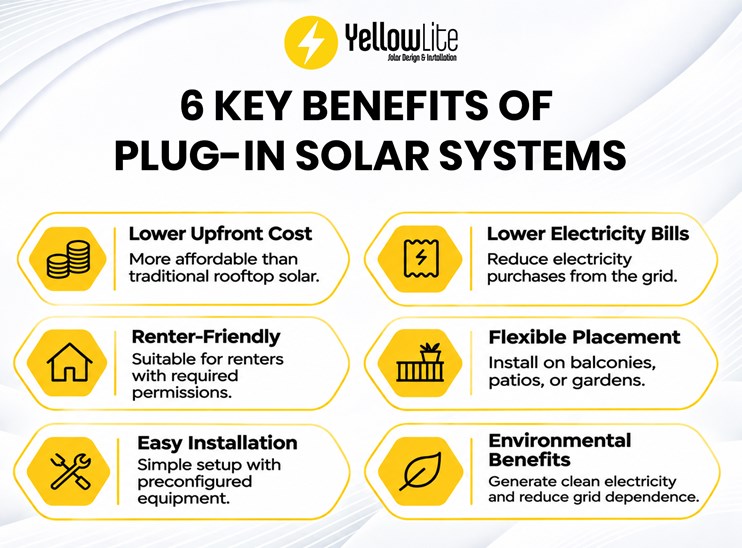
Lower upfront investment
A small plug-and-play solar kit generally costs less than a conventional residential solar installation.
This makes it easier for people with limited budgets to explore solar energy.
Suitable for renters
Renters often cannot make permanent changes to the roof or electrical infrastructure of a property.
Plug-in solar can offer an alternative when the landlord permits the installation and local regulations allow it.
Simple installation
Compared with traditional rooftop solar, qualifying plug-in systems are designed to reduce installation complexity.
Some systems use preconfigured panels, microinverters, mounting equipment, and compatible electrical connections.
Reduced dependence on grid electricity
Solar-generated electricity can offset part of the property's daily electricity consumption.
This is particularly useful for appliances that operate throughout the day, including refrigerators, routers, and other continuously running equipment.
Flexible installation options
Plug-in solar panels can be installed in different outdoor locations instead of relying entirely on available roof space.
Environmental benefits
Generating electricity from sunlight can reduce the amount of electricity that is needed from the grid. This may also reduce associated greenhouse gas emissions, depending on the electricity sources in the local grid.
However, the environmental benefits depend on the equipment's manufacturing, transportation, operating life, and eventual disposal.
5. How Much Money Can Plug-In Solar Panels Save on Electricity Bills?
Electricity savings are one of the biggest reasons people consider plug-in solar panels.
However, the actual savings depend on system capacity, sunlight exposure, local electricity prices, and your electric usage patterns.
According to EnergySage's U.S. market estimates, a typical 400W–800W plug-in solar installation may save approximately 13–50 per month.
An 800W system may generate around 70–110 kWh of electricity per month in suitable conditions. This equals approximately 840–1,320 kWh annually, although actual production varies significantly by location, season, shading, and panel orientation.
Consider the following illustrative estimates:
|
System Size |
Estimated Monthly Generation |
Estimated Annual Generation |
|
400W |
35–55 kWh |
420–660 kWh |
|
800W |
70–110 kWh |
840–1,320 kWh |
These figures are planning estimates, not guaranteed production levels.
Example: How much can an 800W system save?
Suppose your solar panels generate 90 kWh of usable electricity in one month and your local electricity rate is $0.18 per kWh.
Your potential monthly savings would be:
90 kWh × $0.18 = $16.20
Your estimated annual savings would be:
$16.20 × 12 = $194.40
This example assumes that all generated electricity offsets electricity that you would otherwise purchase from your utility. Actual savings may be lower if production exceeds household demand or export compensation is unavailable.
For a location-specific estimate, you can use the PVWatts solar calculator from the National Laboratory of the Rockies.
6. How Much Do Plug-In Solar Systems Cost?
Plug-in solar systems generally have lower upfront costs than traditional rooftop installations.
The price depends on panel capacity, inverter specifications, mounting equipment, battery storage, and the manufacturer's warranty.
For homeowners considering a complete solar installation, understanding the factors affecting solar energy installation costs can help with long-term budget planning.
For U.S. consumers, a typical 400W–800W plug-in solar kit may cost approximately 500–1,500.
|
System Type |
Estimated Price |
Typical Application |
|
|
400W plug-in solar kit |
|
Small household electricity requirements |
|
|
800W plug-in solar kit |
|
Larger electricity offset |
|
|
Plug-in solar with battery storage |
Varies by capacity |
Storing electricity for compatible backup applications |
These are indicative market estimates. Actual prices can vary by retailer, location, product features, and installation requirements.
Are plug-in solar panels cheaper than traditional rooftop solar?
Yes, in terms of initial purchase price.
However, plug-in solar systems generate significantly less electricity than conventional rooftop solar installations.
A plug-in solar kit may cost $1,000, while a full rooftop solar installation may cost tens of thousands of dollars. The two systems are designed for different electricity requirements.
Plug-in solar is useful for offsetting a portion of household electricity consumption. Rooftop solar is generally more suitable for homeowners seeking substantial electricity bill reductions.
7. Is Plug-In Solar Legal in the United States?
Plug-in solar regulations are developing across the United States.
There is no single nationwide rule that automatically allows every homeowner to connect any solar panel system to a standard household outlet.
State laws, utility interconnection requirements, electrical codes, and product certification requirements determine whether a particular installation is permitted.
As of November 2026, ten states have enacted legislation specifically addressing plug-in solar:
- California
- Colorado
- Connecticut
- Maine
- Maryland
- New Hampshire
- New Jersey
- Utah
- Vermont
- Virginia
However, not every enacted law is already effective. Some provisions have implementation dates in 2027, and requirements vary by state.
For example, state legislation may specify maximum system output, acceptable equipment certifications, utility notification requirements, and installation conditions.
In areas without a specific plug-in solar law, existing utility interconnection policies and electrical codes may apply.
Is plug-in solar available in Ohio?
In Ohio, plug-in solar legislation is currently under consideration. A bill in the Ohio House, House Bill 755 (HB 755), is currently awaiting a vote to determine if and how plug-in solar systems will be allowed in the state.
What should homeowners check before installation?
- Whether their state permits plug-in solar installations.
- Whether utility notification or interconnection approval is required.
- Whether the system meets applicable electrical and product certification requirements.
- Whether the landlord, HOA, or property manager permits the installation.
- Whether local building and electrical requirements are satisfied.
Do not assume that a product advertised as plug-and-play in another country can legally be connected to a household outlet in the United States.
8. What Safety Requirements Should You Consider?
Electrical safety is an important consideration when installing plug-in solar panels.
Unlike a standalone portable solar charger, a grid-connected plug-in solar system sends electricity into a property's electrical circuit.
If the equipment is incorrectly designed or connected, it may cause electrical hazards, circuit overloads, or dangerous electricity backfeed.
Before purchasing a system, consider these requirements.
Choose appropriately certified equipment
Check the certification of the complete system and its components.
UL 3700 is a dedicated testing and certification framework for interactive plug-in photovoltaic equipment and systems. Depending on the state and product, other applicable inverter and electrical certifications may also be required.
Do not rely only on a seller's statement that a product is safe or compliant. Ask for the actual certification documentation and confirm which components or complete system it covers.
Check anti-islanding protection
Anti-islanding protection automatically stops a grid-connected inverter from supplying power when utility electricity is interrupted.
This is important because electricity must not continue flowing into utility lines during an outage when electrical workers may be repairing the network.
Inspect electrical outlets and circuits
The outlet and electrical circuit must be suitable for the equipment's operating requirements.
Shared circuits, wiring conditions, grounding, protective devices, and outdoor outlet ratings should be checked as appropriate.
A licensed electrician can help determine whether a dedicated circuit or other electrical work is needed.
Use weather-resistant equipment
Outdoor plug-in solar panels must have suitable weather protection.
Check the ratings of cables, connectors, mounting hardware, and electrical enclosures before installing the system outdoors.
Secure the panels properly
Balcony and garden installations must withstand wind and other local weather conditions.
Incorrect mounting can cause panels to fall, damaging property or injuring people.
Never connect a solar inverter to a wall outlet using an improvised adapter, homemade backfeed connection, or unsuitable extension cord. Follow the manufacturer's installation instructions and applicable local rules.
9. Plug-In Solar Panels vs. Traditional Rooftop Solar Systems
Both plug-in solar and traditional rooftop solar systems generate electricity from sunlight. However, they differ in capacity, installation, cost, and potential savings.
|
Comparison Factor |
Plug-In Solar |
Traditional Rooftop Solar |
|
Installation |
Small, preconfigured system |
Typically professionally installed |
|
System capacity |
Generally 400W–800W |
Commonly several kilowatts |
|
Initial investment |
Lower |
Higher |
|
Roof access |
Not required |
Usually required |
|
Suitable for renters |
Potentially, with permission |
Generally difficult |
|
Electricity savings |
Limited |
Potentially substantial |
|
Battery storage |
Optional |
Optional |
|
Installation space |
Balcony, patio, garden, or fence |
Primarily rooftop |
|
Maintenance |
Relatively simple |
Depends on system design |
|
Best for |
Small electricity offsets |
Larger residential electricity needs |
Which system is better?
Plug-in solar is a practical option for renters and homeowners who cannot install traditional rooftop solar.
However, homeowners with suitable roofs and higher electricity consumption may benefit more from a conventional rooftop installation.
Explore our guide to solar panels for home to understand their costs, potential savings, and long-term investment benefits.
A professionally designed rooftop system can generate significantly more electricity and may offer greater long-term savings.
10. Additional Things to Know Before Buying Plug-In Solar
Beyond costs, legal requirements, and installation, homeowners often have questions about portability, warranties, and electricity generation.
The following table provides answers to some practical questions.
|
Topic |
Answer |
|
Portability |
Some plug-in solar panels are designed to be moved between locations. However, fixed mounting systems and grid-connected electrical equipment must be safely disconnected, relocated, and reinstalled according to manufacturer instructions. |
|
Camping and caravans |
Solar panels can be used for camping and caravans, but a typical plug-in grid-connected solar kit is not the same as an RV solar system. Portable panels with a compatible charge controller and battery power station are generally more suitable for camping. |
|
Different installation locations |
Plug-in solar panels can be installed on suitable balcony railings, patio structures, fences, pergolas, flat roofs, and garden mounts, subject to structural safety and local regulations. |
|
Plug-and-play solar kits |
A typical kit includes solar panels, a microinverter, electrical cables, compatible connectors, mounting equipment, and sometimes monitoring accessories. |
|
Solar panel warranties |
Warranty periods differ between manufacturers and components. Some solar panels have performance warranties extending to 25 years or longer, while microinverter, mounting, cable, and complete-kit warranties may be shorter. |
|
Annual electricity generation |
An 800W system may generate approximately 840–1,320 kWh annually in suitable conditions. Actual generation depends on sunlight, shading, location, and installation angle. |
|
Return on investment |
Payback depends on purchase price and actual electricity savings. A $1,000 system saving $25 per month would have a simple payback of approximately 40 months, excluding maintenance and replacement expenses. |
These factors should be considered before selecting a product because a low purchase price does not necessarily mean the system will provide the best long-term value.
11. Are Plug-In Solar Panels Suitable for Renters and Homeowners?
Yes, plug-in solar can be suitable for both groups, but the installation requirements may differ.
For renters
Plug-in solar is particularly interesting for people who rent apartments or houses.
Renters may not have permission to install permanent rooftop solar panels, but they might have access to a suitable balcony, patio, or garden.
Before purchasing equipment, renters should:
- Check their rental agreement.
- Obtain landlord permission where required.
- Review building and HOA restrictions.
- Confirm whether the mounting arrangement is permitted.
- Check local utility and electrical requirements.
For homeowners
Homeowners generally have more flexibility when selecting installation locations.
They may use a garden, patio, fence, or suitable outdoor structure to mount plug-in solar panels.
However, owners should still check local regulations, electrical requirements, and utility policies.
12. Can Businesses Use Plug-In Solar Panels?
Plug-in solar technology may also be useful for small commercial properties, depending on local regulations and equipment suitability.
For example, small offices, workshops, and accessory buildings may use compact solar systems to offset a portion of their daytime electricity consumption.
However, plug-in systems are not generally designed to meet the electricity requirements of large commercial buildings or industrial facilities.
Businesses with substantial electricity consumption should consider professionally designed commercial rooftop solar or ground-mounted solar installations.
Businesses looking for larger solar installations can explore commercial solar installation services to find solutions designed around their electricity consumption and operational requirements.
These systems can provide higher generation capacity and can be configured with battery storage when required.
Commercial customers should also verify whether applicable state plug-in solar legislation covers non-residential electricity meters and business properties.
Frequently Asked Questions (FAQs)
1. Are plug-in solar panels worth buying?
Yes, plug-in solar panels can be worthwhile for renters, apartment residents, and homeowners who cannot install traditional rooftop solar. They offer a relatively affordable way to reduce a portion of electricity consumption. However, savings depend on system capacity, location, and electricity rates.
2. Do plug-in solar panels work without a battery?
Yes. A typical grid-connected plug-in solar system does not require a battery. It supplies solar electricity to the property's electrical circuit and uses the utility grid when solar generation is insufficient. Without a compatible battery and backup configuration, it generally cannot provide power during an outage.
3. Can I plug a solar panel directly into a wall outlet?
Only a properly designed and approved plug-in solar system should be connected to a household outlet. A bare solar panel cannot simply be plugged into a wall outlet. The system needs suitable power electronics, protection, and compliance with applicable local requirements.
4. Can plug-in solar panels eliminate electricity bills?
No. Most plug-in solar systems have relatively small capacities and are designed to offset a portion of electricity consumption. They generally cannot generate enough power to meet the complete electricity requirements of an average household.
5. How much electricity can an 800W plug-in solar system generate?
An 800W plug-in solar system may generate approximately 70–110 kWh per month under suitable conditions. This equals around 840–1,320 kWh annually. Actual production depends on location, sunlight exposure, shading, and panel orientation.
6. Can plug-in solar panels charge a home battery?
Some plug-in solar products support compatible battery storage, but not every system offers this feature. Check the inverter, battery, and manufacturer's compatibility requirements before purchasing additional storage equipment.
7. Are plug-in solar panels suitable for apartments?
Yes, provided there is an appropriate installation location, landlord or building permission where required, and compliance with electrical and utility regulations. Balcony railings and patios are common installation locations.
8. Do plug-in solar panels work during cloudy weather?
Yes. Solar panels can generate electricity during cloudy conditions, but their output generally decreases because less sunlight reaches the photovoltaic cells.
9. Can I move plug-in solar panels after installation?
Some systems are portable and can be relocated. However, electrical equipment, mounting hardware, and wiring must be safely disconnected and reinstalled according to manufacturer instructions and local requirements.
10. Are plug-in solar panels better than rooftop solar?
They serve different purposes. Plug-in solar is useful for small electricity offsets and properties without suitable roof access. Traditional rooftop solar is generally better for homeowners and businesses seeking substantial electricity generation and larger long-term savings.
Conclusion
Plug-in solar panels are making renewable energy more accessible to people who cannot install traditional rooftop solar systems.
They offer several benefits, including lower upfront costs, flexible installation locations, and the ability to reduce a portion of household electricity consumption.
However, their limited generation capacity means they cannot replace a full residential or commercial solar installation in most situations.
Before purchasing a plug-and-play solar system, compare its price, expected electricity generation, warranty, safety certification, and local installation requirements.
For renters and apartment residents, plug-in solar can be a useful starting point for adopting renewable energy.
For homeowners with suitable roofs and businesses with higher electricity requirements, a conventional solar installation may provide better long-term value. Explore YellowLite's residential and commercial solar services to find a solar solution suited to your property's energy requirements.
Thinking about installing a plug-in solar system?
The right system depends on your property, electricity requirements, and local regulations. To understand whether plug-in solar is suitable for your situation, consider these three details:
- Where do you plan to install it? Balcony railing, garden, patio, or apartment.
- What is your approximate monthly electricity bill or savings goal? This helps estimate the electricity offset you may need.
- Where are you located? Share your U.S. state, city, or ZIP code so you can check applicable local regulations, utility requirements, and installation options