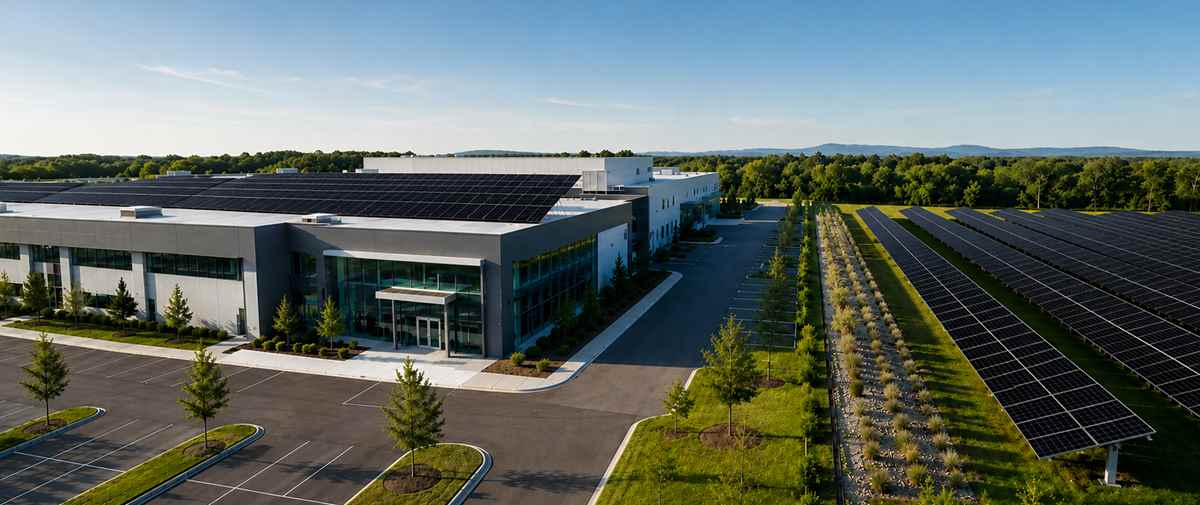



Electricity bills may seem like a routine business expense, but relying entirely on the grid gives companies little control over how those costs change over time. For businesses operating large facilities or using significant power throughout the day, even modest rate increases can place added pressure on margins and long-term budgets.
Solar energy for power generation offers a more proactive approach by allowing businesses to produce electricity onsite, reduce grid dependence, and plan energy spending with greater confidence.
This guide explains how business solar works, what affects system performance, how to evaluate ROI, and when battery storage can add value.
Why Onsite Solar Is Becoming a Business Priority
Solar is no longer limited to sustainability planning. It is becoming part of a broader conversation about overhead and long-term cost control.
When a facility uses the electricity it generates, it purchases less power from the utility. This makes solar panels for business especially relevant for facilities with consistent daytime energy use.
The goal is to produce electricity when the business can use it most effectively.
How Onsite Solar Changes Energy Use
According to the U.S. Department of Energy, solar panels convert sunlight into electricity that can be used directly at your facility. When your system is producing power, your business can use that solar energy first and rely on the grid for any additional electricity it needs.
If your system produces more energy than you are using, the excess can potentially be sent back to the grid or stored in a battery. The best setup depends on your facility’s energy needs, utility rules, and overall goals.
The result? Your business has greater control over the source of its energy.
How Many Panels Does My Facility Need?
Every facility has a different site, operating schedule, electricity profile, and plan for growth. That's why your facility's solar panel system should be customized based on your specific energy and site needs.
|
Factor |
Why It Matters |
|
Electricity usage |
Shows how much energy the facility consumes |
|
Operating hours |
Reveals how closely demand matches solar production |
|
Roof or land |
Determines the available installation area |
|
Peak demand |
Helps assess the value of solar and storage |
|
Future growth |
Accounts for new machinery, EV charging, or expansion |
|
Utility rules |
Affects interconnection and electricity exports |
A proper assessment should review at least 12 months of utility bills, site conditions, structural capacity, and expected changes in future consumption.
How Solar Generation and Battery Storage Work Together
The value of a business solar system depends not only on how much electricity it generates, but also on when that electricity is produced and how closely it matches the facility’s demand. Battery storage can improve that balance, but only when it supports a clear financial or operational need.
What Affects Solar Electricity Generation?
Two identical solar systems can produce different results based on their location, design, and surrounding conditions.
Annual solar energy generation is influenced by:
- Available sunlight and seasonal weather
- Panel orientation, tilt, and shading
- Roof, ground, or carport placement
- Module and inverter efficiency
- Snow, dust, and other production losses
- Equipment condition and maintenance
A site-specific production model brings these factors together to estimate how much electricity the system can generate and how much the facility is likely to use directly.
How Battery Storage Supports Business Energy Needs
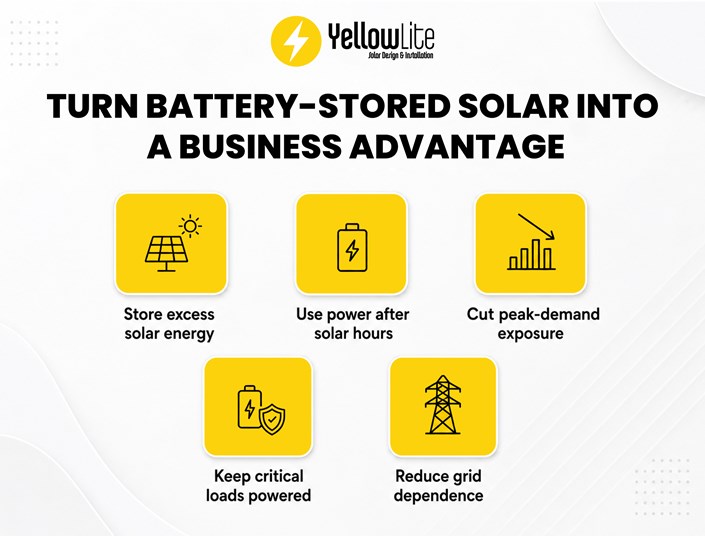
A battery stores electricity that is not needed at the time it is produced. The business can then use that energy later, when solar generation falls or electricity demand increases.
Battery storage may add value when a business wants to:
- Use solar electricity outside peak production hours
- Reduce certain utility demand peaks
- Support essential equipment during an outage
- Improve control over when stored energy is used
- Reduce the amount of excess electricity sent to the grid
Solar alone does not normally provide backup power during a grid outage. According to the U.S. Department of Energy, a facility needs compatible storage, inverter technology, controls, and electrical equipment to operate safely when utility power is unavailable.
For this reason, storage should not be added simply because it is available. Its value should be assessed against the facility’s operating hours, rate structure, outage exposure, critical loads, and overall energy goals.
What Makes the Investment Work?
Solar becomes financially valuable when the system is designed around how the business actually uses electricity, with the right solar financing approach supporting the investment. The goal is not simply to install more panels, but to generate power at the right time while making the project financially practical over the long term.
A strong financial assessment should focus on four areas:
|
What to Review |
Why It Matters |
|
Energy usage |
Shows how much electricity the business can offset |
|
Utility rates |
Helps estimate the value of each unit generated |
|
Project cost |
Determines the amount that must be recovered |
|
Long-term return |
Shows the value created beyond simple payback |
Tax incentives may also improve the numbers. The IRS Clean Electricity Investment Credit can offset 30-60% of the cost to install a solar energy system. Since eligibility differs by project, businesses should confirm the available benefit with a tax professional.
Solar Designed Around How Your Business Operates
No two facilities use energy in the same way, so the right solar system should not start with a standard size or layout. YellowLite designs each system around the property, electricity demand, available space, and plans for future growth.
For example:
- Retail properties may use rooftop systems to preserve customer parking.
- Manufacturing facilities often require larger systems to support higher and more consistent daytime loads.
- Offices and schools may consider ground-mounted systems when roof space is limited or unsuitable.
The goal is to match solar production with the way the facility actually uses electricity, while leaving room for future expansion, new equipment, EV charging, or other energy needs.
Success Story: Sirna & Sons Produce
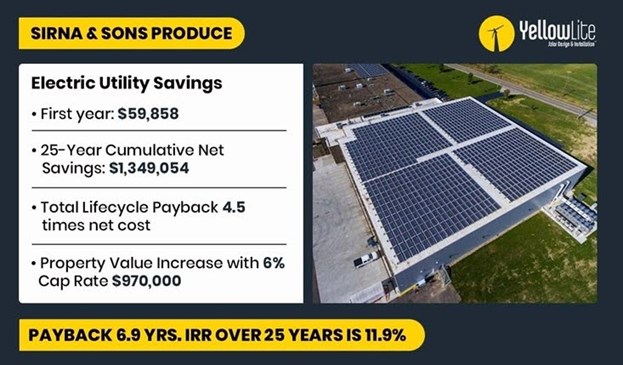
That approach can be seen in YellowLite’s work with Sirna & Sons Produce in the Cleveland area. The system was designed around the facility’s energy requirements and available solar resource.
|
Project Detail |
Result |
|
System Size |
453 kW |
|
Average Peak Sun Hours |
4.2 hours |
|
Estimated Annual Production |
544,165 kWh |
|
Estimated First-Year Utility Savings |
$59,858 |
|
Estimated 25-Year Net Savings |
$1.35 million |
|
Estimated Payback |
6.9 years |
|
25-Year IRR |
11.9% |
The takeaway is not that every business will see the same numbers. It is that system performance and financial return improve when the design starts with the facility’s actual energy profile, site conditions, and long-term objectives.
Start With the Facility, Not the System
The right solar plan begins with understanding the property, the utility bills, and the way the business operates.
YellowLite reviews available space, energy use, operating hours, future expansion, and financial goals before recommending a system. This helps ensure that solar panels for business are designed around a clear purpose rather than offered as a standard package.
Solar energy for power generation can be a strong investment when the system fits both the facility and the business plan.
Frequently Asked Questions
1. How many solar panels does a business need?
The number depends on electricity use, panel wattage, available space, target energy offset, and utility restrictions.
2. Can solar reduce demand charges?
It may help when production overlaps with peak demand. Storage may add value when those peaks occur outside strong solar-production hours.
3. Will solar power a facility during an outage?
Not automatically. Backup power requires compatible storage, inverters, controls, and a system designed to safely support selected loads.
4. What is needed to calculate solar ROI?
A reliable estimate requires utility bills, site data, project cost, production forecasts, financing terms, incentives, and operating assumptions.
5. Do solar panels for business work in Ohio winters?
Yes. They generate throughout the year, although shorter days, cloud cover, snow, orientation, and shading affect seasonal output.