Solar energy is becoming an increasingly popular option for homeowners and businesses looking to reduce electricity bills and gain more control over their energy consumption. However, choosing the right solar system is just as important as selecting the solar panels themselves.
There are three common types of solar installations: on-grid, off-grid, and hybrid solar systems. Each system works differently and offers specific advantages depending on electricity requirements, budget, location, and access to the utility grid.
An on-grid system connects directly to the utility grid and allows excess electricity to be exported. An off-grid system operates independently from the grid and relies on battery storage. A hybrid solar system combines grid connectivity with battery storage, offering greater flexibility and backup power.
Understanding the differences between off-grid and on-grid solar systems, along with hybrid configurations, can help you find the solar setup that works right for you.
Quick Comparison: On-Grid vs. Off-Grid vs. Hybrid Solar Systems
|
Feature |
On-Grid System |
Off-Grid System |
Hybrid System |
|
Grid Connection |
Connected to the utility grid |
Fully independent, no grid connection |
Connected to the grid |
|
Battery Storage |
Optional, usually none |
Required |
Included or optional |
|
Surplus Power |
Sent to the grid through net metering or applicable export arrangements |
Stored in batteries |
Used to charge batteries or exported to the grid |
|
Outage Backup |
None |
Yes, using stored battery power |
Yes, with compatible battery backup |
|
Upfront Cost |
Lower |
Highest due to battery requirements |
Moderate to high |
|
Energy Independence |
Limited |
High |
Moderate to high |
|
Best For |
Areas with few power outages |
Remote locations without grid access |
Homes and businesses needing savings and backup power |
The right system depends on how much electricity you consume, how reliable your local grid is, and whether you need backup power during outages.
1. What Is an On-Grid Solar System?
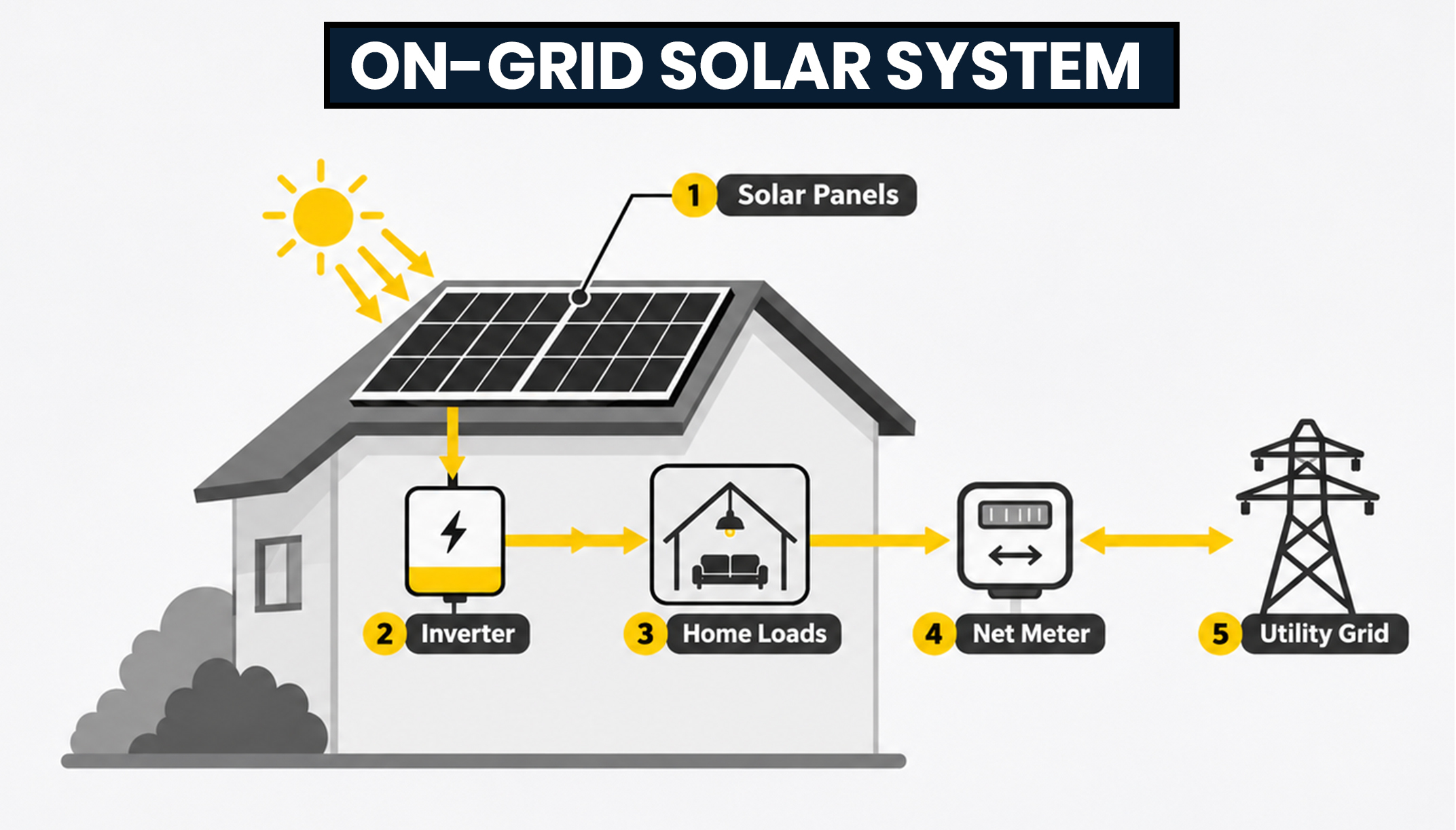
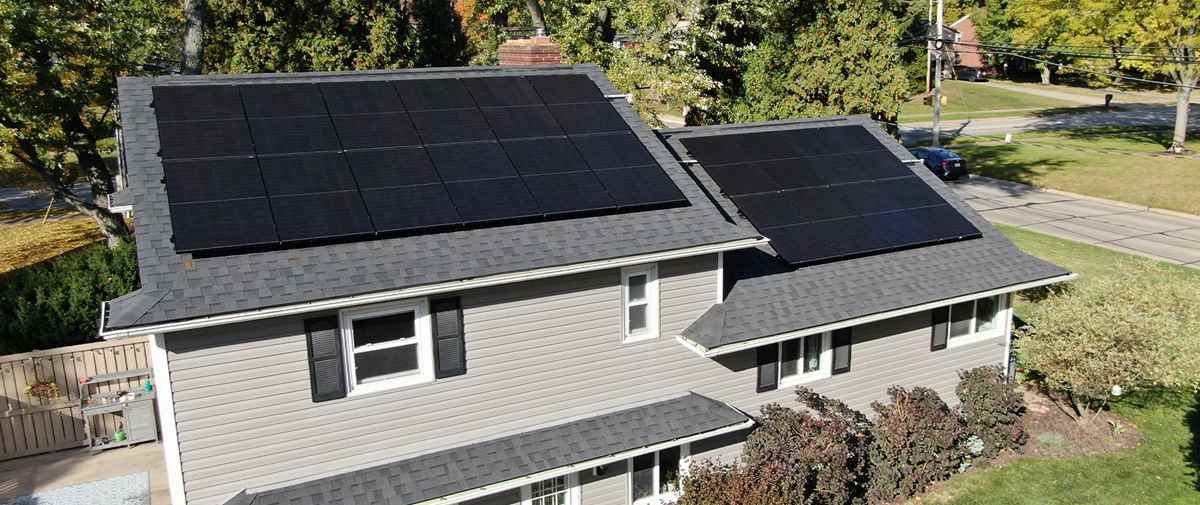
An on-grid solar system, also known as a grid-tied solar system, is connected directly to the local utility electricity network. It generates electricity through solar panels and supplies power to your home or commercial property.
When your solar panels are making less electricity than your home is using electricity from the grid.
When solar panels produce more electricity than your property consumes, the excess electricity can be exported to the grid . Depending on your utility's interconnection and compensation policy, you may get compensated for solar energy that you send back to the grid.
How Does an On-Grid Solar System Work?
An on-grid solar system follows a straightforward process:
- Solar panels capture sunlight and generate direct current (DC) electricity.
- A solar inverter converts DC electricity into alternating current (AC).
- The generated electricity powers household appliances or business equipment.
- Excess electricity is exported to the utility grid when permitted.
- Electricity is imported from the grid when solar production is insufficient.
For example, a homeowner may generate more electricity than they need during the afternoon. The surplus electricity is exported to the utility grid, while electricity can be imported during the evening.
This arrangement helps reduce dependence on purchased electricity without requiring a large battery bank.
Does an On-Grid Solar System Require Batteries?
No. A standard on-grid solar system generally does not require battery storage.
It uses the utility grid as its source of additional electricity when solar generation is unavailable. This makes the system less expensive and easier to install than a comparable system designed for off-grid operation.
However, a standard grid-tied solar system usually shuts down during a utility power outage. This happens to prevent the solar panels from sending electricity into utility lines that may be under repair.
Homeowners who need backup power must install an appropriately configured battery system or another approved backup solution.
Advantages of On-Grid Solar Systems
- Lower installation costs: No battery bank is required in a standard configuration.
- Reduced electricity bills: Solar-generated electricity offsets the power purchased from the utility.
- Net metering opportunities: Eligible customers may receive bill credits for surplus electricity.
- Simpler maintenance: There are fewer components compared with systems that include batteries.
- Suitable for urban properties: Works well where reliable utility grid access is available.
Limitations of On-Grid Solar Systems
- No backup electricity during outages with a standard grid-tied configuration.
- Savings depend on local electricity rates and export compensation policies.
- Customers remain connected to the utility grid.
- Electricity bills may still include fixed charges and other non-energy fees.
2. What Is an Off-Grid Solar System?
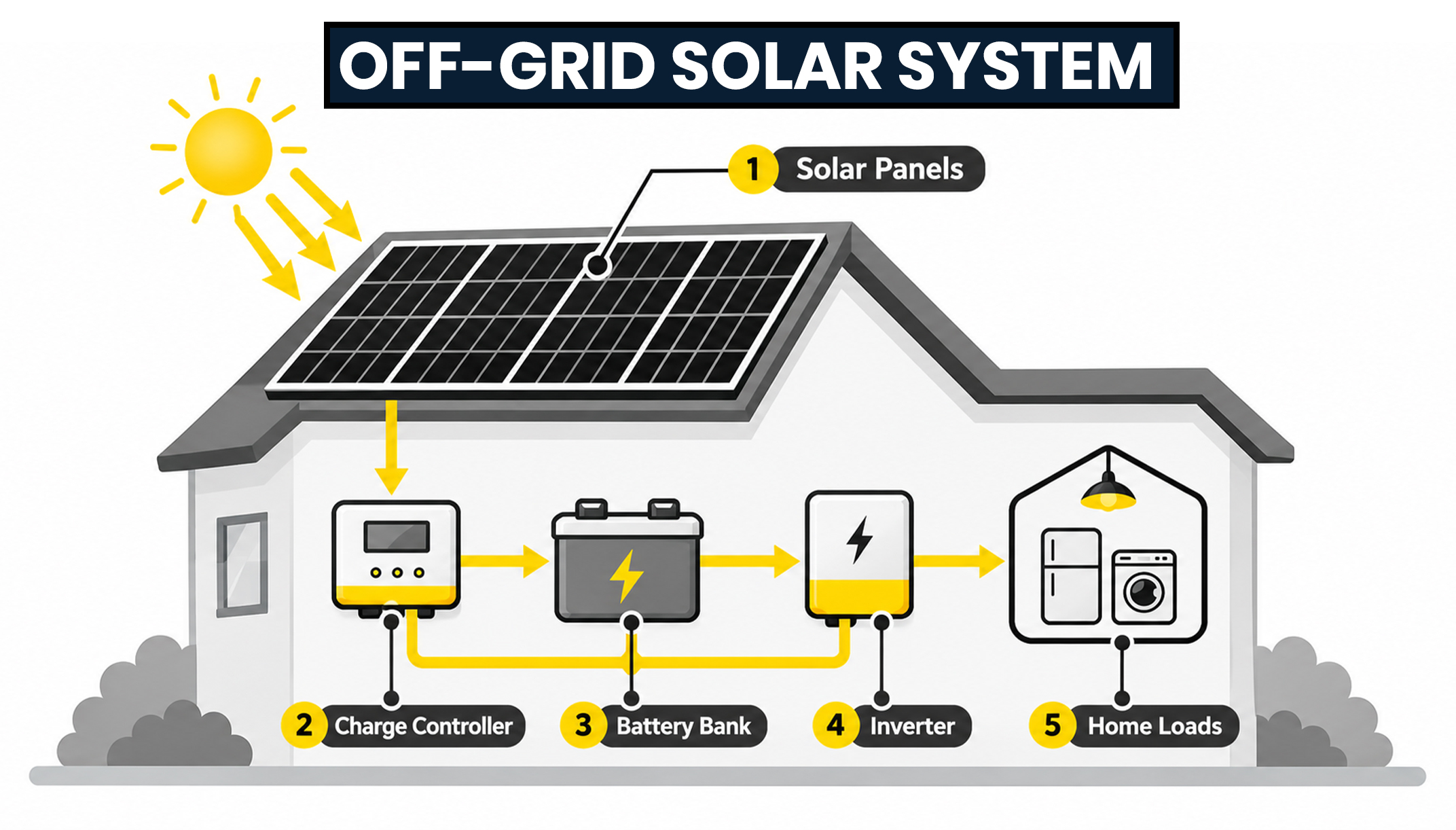
An off-grid solar system is a standalone solar installation that operates independently from the utility electricity grid.
Unlike grid-tied systems, off-grid solar power systems rely on battery storage to provide electricity when solar panels are not generating enough power.
These systems are particularly useful for remote homes, cabins, agricultural properties, and commercial facilities where connecting to the utility grid is difficult or expensive.
How Does an Off-Grid Solar System Work?
An off-grid solar electric system works by generating, storing, and distributing electricity without relying on the utility grid.
Here's how that works :
- Solar panels generate DC electricity from sunlight.
- A charge controller regulates the electricity going into the battery bank.
- Batteries store excess electricity for later use.
- An inverter converts stored DC electricity into AC power.
- Electricity is supplied to household appliances or commercial equipment.
For example, a remote property can generate electricity during the day and store unused power in its batteries. At night, the stored electricity supplies lighting, refrigeration, communication equipment, and other essential loads.
Why Do Off-Grid Solar Systems Require Batteries?
Off-grid systems cannot import electricity from a utility provider when solar production falls.
Therefore, batteries are essential for storing electricity generated during sunny hours and supplying it during nighttime,cloudy weather and times when the property's electric usage is higher than the solar production .
Battery capacity must be carefully calculated based on daily electricity consumption, expected periods without adequate sunlight, and required backup duration.
A backup generator may also be necessary for locations experiencing extended cloudy weather or unusually high electricity demand.
Advantages of Off-Grid Solar Systems
- Energy independence: Operates without depending on a utility electricity connection.
- Suitable for remote properties: Useful in locations where grid extension is unavailable or expensive.
- Backup power: Stored electricity can supply power at night and during periods of low solar production.
- Greater control: Property owners can manage their electricity generation and consumption.
- Reduced utility dependence: No regular electricity purchases from a utility are necessary once the system is operating independently.
Limitations of Off-Grid Solar Systems
- Higher initial installation costs due to battery storage.
- Batteries eventually require replacement.
- Larger systems may be necessary to manage seasonal changes in solar production.
- Backup generators may be needed during extended periods of limited sunlight.
- System sizing and maintenance require careful planning.
3. What Is a Hybrid Solar System?
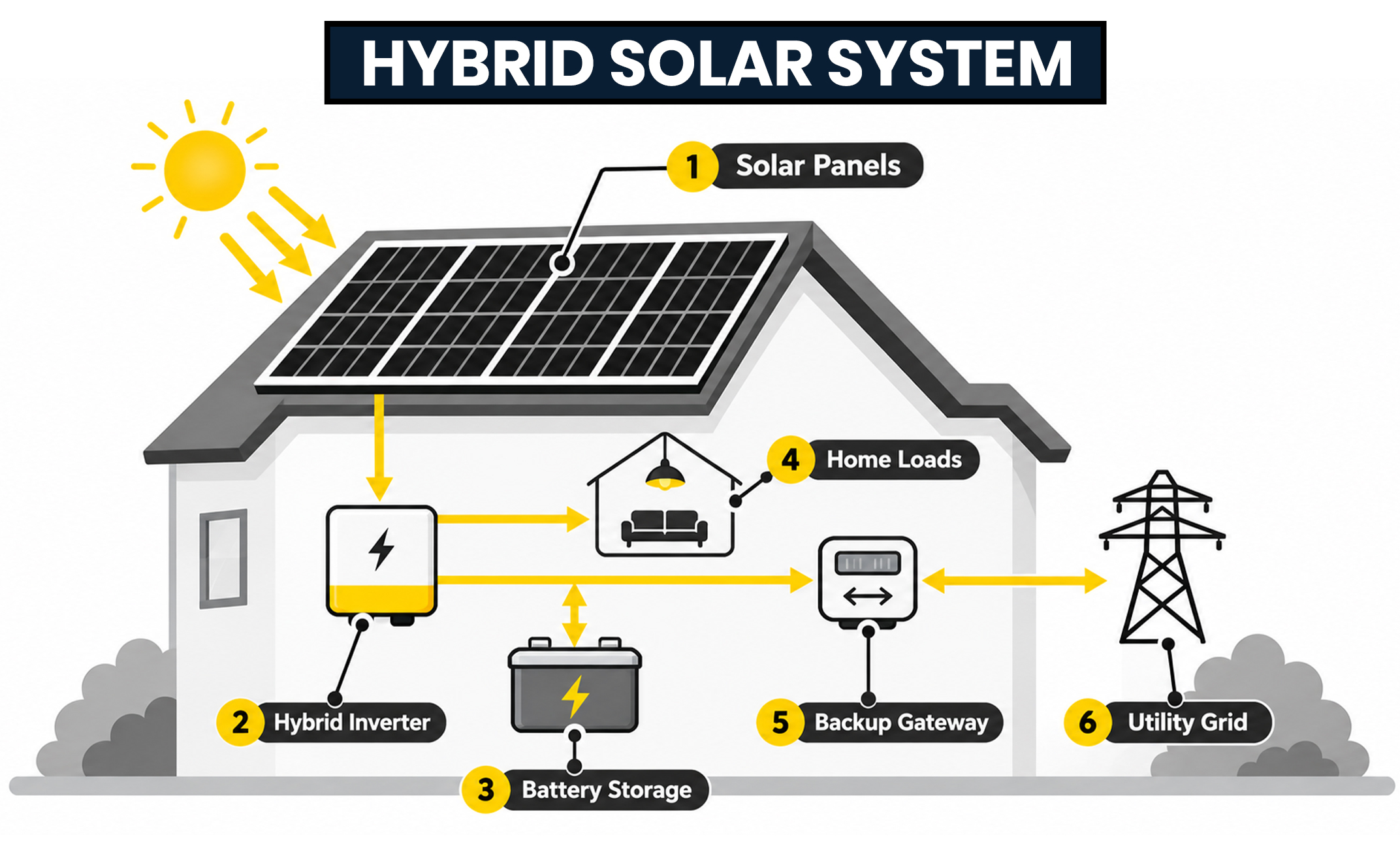
A hybrid solar system combines a grid-connected solar installation with battery storage.
Property owners interested in storing excess solar electricity can explore solar energy storage solutions to understand available battery options and backup power configurations.
It allows homeowners and businesses to use solar electricity, store excess power, export eligible surplus electricity to the utility grid, and use stored energy when solar production is low.
Unlike a standard on-grid system, a hybrid configuration can provide backup electricity during utility outages when it includes a compatible battery, inverter, and backup switching equipment.
How Does a Hybrid Solar System Work?
A hybrid solar system generally operates in the following way:
- Solar panels generate DC electricity.
- A hybrid inverter manages electricity generated by the solar panels.
- Solar electricity first supplies the property's active electricity requirements.
- Excess electricity charges the connected battery bank.
- Additional surplus electricity may be exported to the utility grid.
- When solar production decreases, the battery supplies stored electricity.
- During an outage, the system can disconnect from the utility grid and supply designated backup loads.
The system's operating settings determine whether stored electricity is reserved for outages, used during peak electricity rates, or consumed to reduce grid purchases.
Why Choose a Hybrid Solar System?
Hybrid systems offer a balance between grid connectivity and energy independence.
For example, a business may use solar electricity during working hours, charge its battery when production exceeds consumption, and use stored electricity during expensive peak-rate periods.
If the utility supply fails, a properly configured hybrid system can continue supplying selected equipment.
Advantages of Hybrid Solar Systems
- Provides backup electricity during grid outages.
- Stores surplus solar electricity for later use.
- Can reduce electricity purchases during high-rate periods.
- Maintains a connection to the utility grid.
- Offers greater energy flexibility than standard grid-tied installations.
- Can support backup requirements for homes and commercial buildings.
Limitations of Hybrid Solar Systems
- Higher installation costs than standard on-grid systems.
- Requires compatible batteries and inverter equipment.
- Battery replacement creates additional long-term expenses.
- Backup capacity depends on battery size and inverter power.
- Installation and configuration can be more complex.
4. What Is the Difference Between On-Grid, Off-Grid, and Hybrid Solar Systems?
The biggest difference is how each system manages electricity generation, storage, and utility connectivity.
An on-grid system relies on the utility network when solar electricity is insufficient. An off-grid system uses batteries and potentially a generator to operate independently. A hybrid system combines grid connectivity with battery storage.
Consider the following comparison:
|
Comparison Factor |
On-Grid |
Off-Grid |
Hybrid |
|
Utility connection |
Yes |
No |
Yes |
|
Battery requirement |
Not normally required |
Essential |
Required for battery backup |
|
Grid electricity |
Available |
Not available |
Available |
|
Backup during outages |
No, without additional backup equipment |
Yes |
Yes, with compatible equipment |
|
Installation complexity |
Low to moderate |
High |
Moderate to high |
|
Maintenance |
Minimal |
More involved |
Minimal |
|
Energy independence |
Low |
High |
Moderate to high |
|
Initial investment |
Lowest |
Highest |
Intermediate in many installations |
One important consideration is that a hybrid system does not automatically provide whole-property backup. It must have a battery storage system attached to it in order to provide backup during power outages.
5. Which Solar System Is Cheaper to Install?
Installation costs depend on system capacity, equipment quality, location, roof conditions, labor, and electrical requirements.
In general, an on-grid solar system is the least expensive option because it does not require battery storage.
Off-grid systems usually cost more because they need batteries, charge controllers, additional protection equipment, and sometimes backup generators.
Hybrid systems also cost more than standard grid-tied systems because they include battery storage and additional energy management equipment.
Estimated Solar Installation Costs in the United States
The following figures are illustrative planning estimates for the U.S. market, not guaranteed installer quotes.
|
System Type |
Example System |
Estimated Installed Cost |
|
On-grid residential |
10 kW solar system |
Around $25,800 |
|
Hybrid residential |
10 kW solar + 13.5 kWh battery |
Approximately $35,000–$45,000 |
|
Off-grid residential |
10 kW solar + 20–30 kWh battery |
Approximately $49,000–$65,000+ |
|
Commercial on-grid |
250 kW solar system |
Around $495,000 |
|
Commercial solar + storage |
250 kW solar + 500 kWh storage |
Around $745,000 |
The 10 kW residential solar estimate is based on 2026 EnergySage marketplace pricing. The residential battery estimate uses its reported average installed battery cost of $15,647. The hybrid and off-grid figures are illustrative combinations, with additional allowances for system-specific equipment.
Commercial benchmarks are based on the U.S. Department of Energy's 2025Q1 modeled market prices for representative commercial PV and PV-plus-storage systems. Actual projects can differ significantly.
The additional cost of batteries comes from the battery modules, battery inverter or hybrid inverter, electrical protection, installation, and monitoring equipment.
For off-grid properties, the cost may increase further when larger storage capacity, generator backup, and additional electrical infrastructure are required.
6. How Do Solar Systems Reduce Electricity Bills?
Solar panels reduce electricity bills by generating electricity instead of purchasing it from the utility.
How much money you save depends on how much energy your panels make, how much energy you use, how much your utility charges you for electricity, and how your utility credits you for solar energy that you send back to the grid.
For example, a home that uses electricity during the day can directly consume solar-generated power. This reduces the amount of electricity purchased from the utility.
If solar panels generate more electricity than the property needs, the surplus may be exported to the grid.
What Is Net Metering?
Net metering is a billing arrangement in which eligible customers receive credits for electricity supplied to the utility grid by their solar installations.
These credits can offset electricity imported from the grid, depending on the applicable utility rules.
However, net metering is not the same across the United States.
Some utilities offer credits close to the retail electricity rate, while others use net billing or avoided-cost compensation, which may pay less for exported electricity.
Some programs also have specific credit rollover periods, system-size restrictions, and monthly fees.
Before choosing an on-grid or hybrid system, check your utility's current export compensation policy. The value of exported electricity can significantly affect your solar savings.
7. What Equipment Is Required for Each Solar System?
Although all three configurations use solar panels, their additional equipment requirements are different.
On-grid system:
- Solar panels
- Grid-tied inverter or microinverters
- Mounting equipment
- Electrical disconnect switch
- Production monitoring equipment
- Utility-approved bidirectional meter or metering arrangement
Off-grid system:
- Solar panels
- Off-grid inverter
- Battery bank
- Solar charge controller, where not integrated into the inverter
- Battery management system
- Electrical protection and monitoring equipment
- Backup generator, where required
Hybrid system:
- Solar panels
- Hybrid inverter or compatible AC/DC-coupled equipment
- Battery storage
- Battery management system
- Backup gateway or automatic transfer equipment
- Critical-loads subpanel, where required
- Monitoring and electrical protection equipment
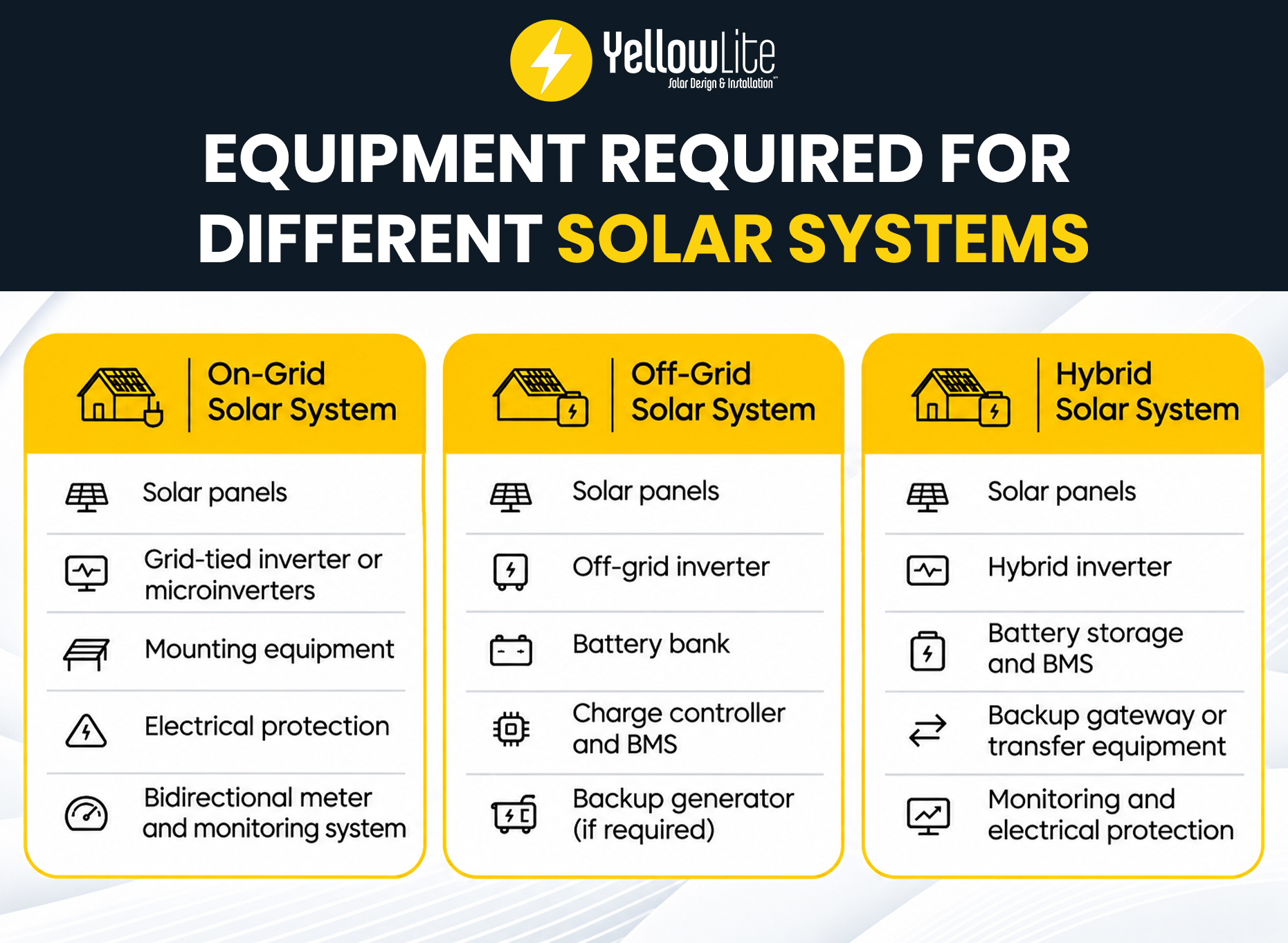
The equipment selected determines how efficiently the system manages electricity, stores energy, and supplies backup power.
Installation requirements also vary. Off-grid installations generally need more detailed planning because the system must be sized to support the property's electricity needs without utility assistance.
8. Federal Solar Tax Credits and Other Incentives in the United States
Federal incentives can affect the overall cost of solar installations
Commercial Solar and Battery Incentives
Non-profits Businesses and churches may qualify for the Clean Electricity Investment Credit under Section 48E, subject to applicable project requirements.
The solar tax credit can offset 30-50% of the cost to go solar.
However, recent legislation accelerated the termination of certain federal incentives for solar and wind facilities. Construction-start dates, placed-in-service deadlines, transition rules, and restrictions involving prohibited foreign entities can affect eligibility.
Standalone energy storage has separate provisions under Section 48E, so businesses should evaluate solar generation and battery investments separately.
9. Which Solar System Is Best for Homes and Businesses?
There is no single solar system that works best for every property. The right configuration depends on energy consumption, utility access, backup requirements, installation budget, and expected financial returns.
For Residential Properties
An on-grid system is suitable for homeowners who have reliable utility access and primarily want to reduce electricity bills.
Homeowners considering this option can explore professional residential solar panel installation to understand available system configurations and potential electricity savings.
A hybrid system may be a better option for homes that experience frequent power outages or want to store electricity for evening consumption.
Off-grid systems are generally more suitable for remote homes that cannot connect to the utility network.
For Commercial Properties
Commercial buildings often consume substantial electricity during business hours, making grid-tied solar the most practical option.
Businesses evaluating this option can explore commercial solar systems designed around their facility's electricity consumption, energy requirements, and long-term savings goals.
Businesses with high electricity demand charges or peak-time electricity rates may benefit from hybrid systems that combine solar generation and battery storage.
For facilities that operate in remote locations, an off-grid system may provide a practical alternative to expensive grid extensions.
For Locations With Unreliable Electricity
Hybrid and off-grid systems are generally more suitable for locations with frequent electricity interruptions.
A hybrid system maintains grid connectivity while providing battery backup. An off-grid system offers full independence from the utility network but requires more extensive battery planning.
Businesses operating critical equipment should also evaluate generator backup and the required duration of uninterrupted electricity.

Frequently Asked Questions (FAQs)
1. What is the main difference between on-grid and off-grid solar systems?
An on-grid solar system connects to the utility electricity network and can export surplus electricity. An off-grid solar system operates independently and relies on batteries to store electricity for use when solar panels are not generating power.
2. Is a hybrid solar system better than an on-grid system?
A hybrid system offers additional flexibility because it combines grid connectivity with battery storage. It can provide backup power during outages, while a standard on-grid system generally cannot. However, hybrid installations cost more.
3. Can an on-grid solar system work during a power outage?
A standard on-grid solar system generally shuts down during a power outage because of anti-islanding safety requirements. A specially configured solar-plus-battery system can supply backup electricity when the utility grid is unavailable.
4. How many batteries are required for an off-grid solar system?
The number of batteries depends on daily electricity consumption, required backup duration, battery capacity, and usable depth of discharge. A property with higher electricity requirements will generally need a larger battery bank.
5. Do hybrid solar systems send excess electricity back to the grid?
Yes. A hybrid solar system can export excess electricity after meeting property consumption and battery charging requirements. However, export permissions and compensation depend on the utility's interconnection and billing policies.
6. Can I convert an on-grid solar system into a hybrid system?
Yes, in many cases. Homeowners may be able to add compatible battery storage and backup equipment to an existing grid-tied installation. However, inverter compatibility, electrical configuration, and utility approval must be checked before making changes.
7. Are off-grid solar systems more expensive than on-grid systems?
Yes, in most comparable installations. Off-grid systems require battery storage, additional power management equipment, and sometimes a backup generator. These components increase initial installation costs.
8. Which solar system provides the best return on investment?
An on-grid system may offer a better financial return where utility electricity rates are high and exported electricity receives favorable credits. A hybrid system may provide additional value through backup power and peak-rate management. The best investment depends on local utility rates and project costs.
Conclusion
On-grid, off-grid, and hybrid solar systems offer different solutions for residential and commercial electricity requirements.
On-grid systems are generally the most affordable option for properties with reliable utility access. Off-grid systems provide energy independence for remote locations but require sufficient battery storage and careful system planning. Hybrid systems combine grid connectivity with battery backup, making them a flexible option for homeowners and businesses that need greater control over their electricity supply.
Before selecting a system, evaluate your electricity consumption, available installation space, utility export rates, backup requirements, and total project budget.
Choosing the right solar configuration can help reduce long-term electricity expenses while meeting your energy needs. YellowLite can help you explore suitable solar solutions for your home or business and make an informed decision about your solar investment.