


For an Ohio facility manager, a higher electricity bill does not always mean the business used more power.
The production floor may be running the same shifts. HVAC schedules may be unchanged. Occupancy may look much the same. Yet rising commercial electricity rates can still push the monthly bill in the wrong direction.
That is what makes energy costs worth a closer look in 2026.
For businesses, the real question is not simply, “Why is electricity getting more expensive?” It is understanding what is driving those costs and where there is room to respond, whether through smarter energy management or commercial solar panels.
This blog breaks down the key factors behind rising electricity costs in Ohio and the practical areas facility leaders can still control.
What Is Driving Ohio Commercial Electricity Rates Higher in 2026?
Ohio businesses operate within the PJM, where electricity supply, regional demand, generation capacity, transmission needs, and utility-related charges can all influence commercial electricity rates.
In 2026, one of the biggest pressures is the growing gap between rising electricity demand and the generation needed to reliably meet it. Data center expansion, electrification, and broader economic activity are adding more demand to the regional grid.
At the same time, maintaining enough power for periods of peak usage is becoming more costly.
Capacity is not the only factor shaping a business electricity bill, but it is part of a larger market shift. For Ohio businesses, this means forces beyond the facility itself are increasingly influencing electricity costs.
Why Rising Rates Do Not Affect Every Ohio Business the Same Way
Higher electricity rates do not affect every business equally. Two facilities with similar monthly usage can still see very different bills because business electricity costs depend on more than total consumption.
Key factors include:
- Peak demand
- Utility rate class
- Supplier agreement
- Transmission and distribution charges
- Timing of major electrical loads
For businesses looking to bring more control to their electricity bills, commercial solar panels can be a practical switch. By generating a portion of the facility’s power onsite, businesses can reduce the amount of electricity they need to purchase from the grid, helping lower long-term energy costs and reduce exposure to rising rates.
How Can Commercial Solar Give Facility Leaders More Control?
Facility leaders cannot control regional electricity markets, utility-wide changes, or future commercial electricity rates. What they can control is how much electricity their facility continues to purchase from the grid.
That is where installing solar panels can change the equation.
Instead of treating every increase in electricity prices as another operating cost to absorb, businesses can generate part of their electricity onsite and reduce their dependence on grid-purchased power.
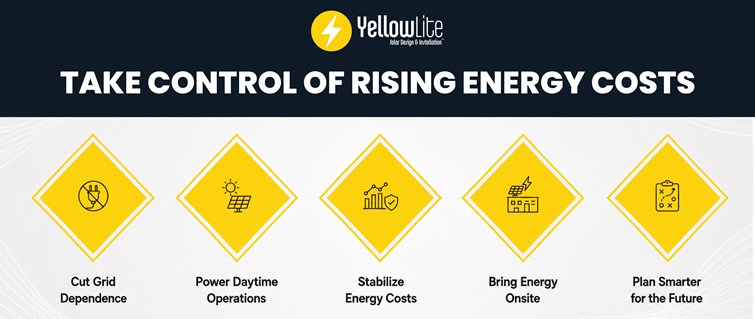
Here is where solar can make a practical difference:
|
Energy Challenge |
How Commercial Solar Helps |
|
Rising grid electricity costs |
Reduces the amount of electricity purchased from the utility |
|
High daytime electricity use |
Produces power when many businesses are actively operating |
|
Long-term energy uncertainty |
Adds a predictable source of onsite generation |
|
Dependence on utility power |
Shifts part of the facility’s energy supply onsite |
|
Future energy planning |
Gives businesses greater control over how power is sourced |
The opportunity, however, depends on designing the system around the facility rather than simply installing as many panels as possible.
Start With How Your Facility Uses Electricity
Before installing solar panels, the first step should be understanding the building’s actual energy profile.
Review electricity consumption, operating hours, seasonal changes, peak-demand periods, and major loads such as HVAC, manufacturing equipment, refrigeration, lighting, or EV charging.
This helps answer an important question:
How much of the facility’s electricity demand can solar realistically offset?
For businesses with strong daytime energy use, solar generation can often align naturally with operating hours, allowing more of the electricity produced onsite to be used directly by the facility.
Size Solar Around the Bill, Not Just the Roof
A large roof does not automatically mean a business needs the largest possible solar system.
The better approach is to design commercial solar around:
- Current electricity consumption
- Daytime load patterns
- Available roof or ground space
- Utility rate structure
- Future facility expansion
- Business savings goals
A properly sized system is built around reducing the facility’s business electricity cost, not simply maximizing panel count.
That distinction matters because the value of commercial solar comes from how well onsite generation matches the way the business actually consumes power.
Replace More Grid Power With Onsite Solar
Every unit of solar electricity used directly by the facility is electricity that does not need to be purchased from the grid at that moment.
For businesses operating heavily during daylight hours, this can make commercial solar particularly valuable.
Manufacturing facilities, offices, dealerships, warehouses, healthcare properties, schools, and other daytime operations may be able to use a significant share of solar production as it is generated.
Over time, this can help reduce exposure to future electricity-price changes and make energy expenses easier to plan.
When Does Battery Storage Strengthen a Commercial Solar System?
Commercial solar primarily generates electricity during daylight hours. Battery storage can extend the value of that energy by storing power for later use.
For some commercial properties, pairing solar with battery storage can create additional flexibility by helping businesses:
- Use stored solar energy later in the day
- Reduce reliance on grid power during selected periods
- Manage certain demand peaks
- Support critical loads during outages
- Build greater energy resilience
Battery storage does not need to accompany every commercial solar installation.
Its value depends on the facility’s electricity usage, operational priorities, rate structure, and backup-power requirements. The right approach is to evaluate storage as part of the overall energy strategy rather than adding it automatically.
Turn Rising Electricity Costs Into a Reason to Rethink Your Energy Source
Businesses may not be able to control where electricity prices move next, but they can take more control over where their power comes from. Installing solar panels allows Ohio businesses to generate a portion of their electricity onsite, reduce dependence on grid-purchased power, and build a more predictable long-term energy strategy.
At YellowLite, that starts with understanding the facility first. The team reviews electricity usage, operating patterns, available roof or ground space, and future energy needs before recommending a system.
This helps ensure the solar installation is designed around how the business actually uses power, rather than simply maximizing the number of panels. The goal is to create a commercial solar solution that supports meaningful energy savings and long-term operational value.

Frequently Asked Questions
1. Can solar panels lower electricity bills for Ohio businesses?
Yes. Commercial solar panels generate electricity onsite, which can reduce the amount of power a business needs to purchase from the utility. The potential savings depend on electricity usage, system size, solar production, utility rates, and how closely generation matches the facility’s operating hours.
2. Which businesses benefit most from solar panels?
Businesses with substantial daytime electricity consumption are often strong candidates for commercial solar. This can include manufacturing facilities, warehouses, offices, hotels, dealerships, healthcare properties, schools, and other commercial buildings with suitable roof or ground space.
3. How are solar panels sized for a business?
Commercial solar systems should be sized using the facility’s electricity consumption, load profile, available installation area, utility rate structure, operating hours, and future energy needs. The goal should be to create meaningful energy savings rather than simply install the maximum number of panels.
4. Can commercial solar reduce exposure to rising electricity rates?
Commercial solar can reduce the amount of electricity a business purchases from the grid while the system is producing power. This means a portion of the facility’s electricity needs becomes less dependent on future changes in grid electricity prices.
5. Do commercial solar panels help with peak demand charges?
Solar may help reduce grid demand during periods when solar production overlaps with the facility’s peak electricity use. However, results depend on when the facility reaches its peak demand. Battery storage may provide additional demand-management opportunities for certain businesses.