A low solar bid can look like a financial win until the missing costs begin to surface. For business owners, CFOs, and facility managers, two proposals may appear nearly identical while relying on very different designs, installation scopes, service commitments, and equipment.
Choosing high quality solar panels may raise the upfront cost, but it can support stronger performance, reliability, and long-term value. The price on the final page rarely tells the whole story. A sound comparison should also examine workmanship, warranties, exclusions, projected energy output, maintenance requirements, and the support available throughout the system’s lifespan.
The Price Gaps Hidden Inside Commercial Solar Proposals
Commercial solar bids vary because they may not be pricing the same project, even when the proposed systems appear similar.
One installer may include structural engineering, electrical upgrades, utility interconnection, monitoring, permitting, and post-installation support. Another may price only the core equipment and installation, leaving additional work to be billed later or handled by the property owner.
The commercial solar panel cost is therefore more than the price of the panels. It can include design and engineering, inverters, racking, electrical equipment, labor, roof or ground-mount requirements, permitting, inspections, utility coordination, monitoring, commissioning, and ongoing service.
Several property-specific factors can also affect solar system pricing:
- Roof condition, material, pitch, and available area
- Existing electrical infrastructure and service capacity
- Required structural or electrical upgrades
- Trenching, conduit runs, or difficult equipment access
- Local permitting and inspection requirements
- Utility interconnection requirements
- Operational restrictions during installation
- Safety procedures for an active commercial site
An unusually low proposal is not automatically incomplete. However, decision-makers should confirm exactly what is included. A proposal may exclude roof repairs, switchgear upgrades, transformer work, permit fees, utility costs, monitoring subscriptions, or restoration work after trenching.
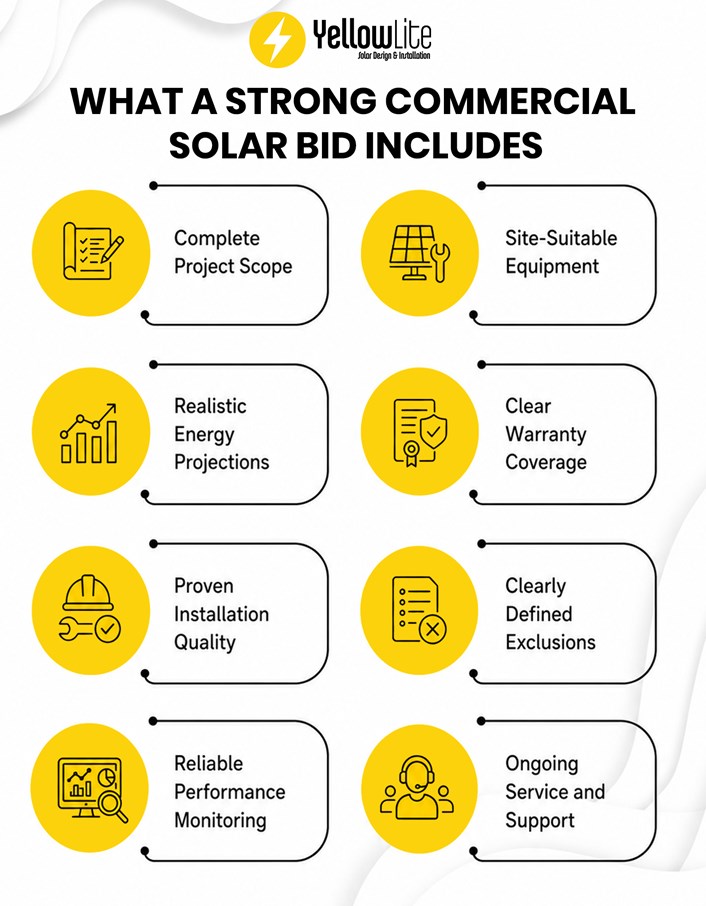
These exclusions can change the final solar installation cost and affect the project schedule. Every commercial solar proposal should identify included work, exclusions, allowances, and the party responsible for each project requirement.
High Quality Solar Panels and Equipment Protect Long-Term Output
High quality solar panels support reliable production, but panel selection is only one part of equipment quality. Inverters, racking, wiring, connectors, monitoring hardware, and other balance-of-system components also influence system uptime and long-term performance.
Commercial buyers should compare more than panel wattage. Relevant factors include expected degradation, product and performance warranty terms, manufacturer strength, equipment compatibility, and suitability for the property’s operating conditions.
A panel with strong specifications may still be the wrong choice if it does not fit the roof layout, mounting system, electrical design, or project economics. Likewise, selecting premium equipment does not correct a poorly designed system.
Equipment Choices Should Support the Business Case
There is no single panel, inverter, or mounting solution that is best for every commercial property. Equipment should be selected according to factors such as:
- Available installation space
- Roof or ground conditions
- Weather exposure
- Shading and orientation
- Facility energy demand
- Maintenance access
- Expansion plans
- Budget and financial priorities
Warranty comparisons also require more than checking the number of covered years. Businesses should review what each warranty covers, who administers it, whether labor is included, and how a claim would be handled.
Manufacturer warranties and installer workmanship warranties serve different purposes. One may cover a defective component, while the other may address installation-related issues. The proposal should explain these responsibilities clearly.
A coordinated equipment package, designed around the site and supported by clear warranties, can reduce avoidable performance and service concerns later.
Where a Low Bid Can Create High Installation Costs
Installation quality affects safety, roof integrity, code compliance, system performance, and future maintenance. For that reason, workmanship belongs in the financial comparison, not outside it.
Commercial solar installation requires careful coordination with facility operations, property access, electrical systems, roofing conditions, inspections, and utility requirements. Mistakes involving penetrations, wiring, equipment placement, drainage, or labeling can create costs that do not appear in the original bid.
A qualified commercial solar installer should be able to explain its approach to:
- Site assessment and constructability
- Structural and electrical engineering
- Roof protection and attachment methods
- Equipment placement and service access
- Code compliance and inspections
- Installation quality control
- System testing and commissioning
- Project records and closeout documentation
Commercial experience becomes especially important when a business must remain operational during installation. The contractor may need to work around production schedules, deliveries, customer access, safety zones, and planned shutdowns.
The proposal should also define who will monitor the system, respond to performance issues, and handle ongoing maintenance. Strong workmanship and clearly assigned support help protect system uptime, safety, and long-term solar savings.
Compare Lifetime Value, Not Just the Lowest Bid
The strongest proposal is the one that clearly connects project cost with expected performance, risk, and service over the system’s working life. It does not have to be the most expensive option. It should be complete, transparent, and suited to the business.
|
Proposal Factor |
Low-Price Evaluation |
Long-Term Value Evaluation |
|
Equipment |
Lowest equipment price |
Quality, compatibility, and site suitability |
|
Production estimates |
Largest projected output |
Documented assumptions and realistic modeling |
|
Warranty coverage |
Warranty length only |
Coverage, exclusions, labor, and claim process |
|
Installation scope |
Base installation price |
Complete engineering, construction, and commissioning scope |
|
Service |
Support after installation |
Defined monitoring, response, and maintenance responsibilities |
|
Exclusions |
Reviewed after selection |
Identified and priced before approval |
|
Monitoring |
Included or not included |
Platform access, alerts, reporting, and ongoing costs |
|
Projected ROI |
Shortest stated payback |
Transparent inputs, assumptions, and sensitivity to change |
Production estimates deserve particular attention because projected output influences commercial solar ROI. Businesses should ask how shading, weather, orientation, equipment losses, degradation, and downtime are reflected in the model.
Financial projections should also explain the assumptions used for energy rates, operating costs, incentives, tax treatment, and financing. Because tax and incentive eligibility can vary by project and current regulations, businesses should consult qualified financial and tax professionals.
A strong commercial solar proposal makes its costs, responsibilities, and performance assumptions easy to understand. Comparing these details upfront can help prevent unexpected expenses and support better long-term value.
Choose the Proposal That Keeps Working After Installation
The lowest initial bid and the lowest lifetime cost are not always the same. The real value of a business solar investment depends on the relationship among high quality solar panels, site-specific design, experienced installation, realistic production assumptions, clear warranties, and dependable service.
A strong proposal makes those elements visible. It explains what is included, identifies potential added costs, and gives decision-makers a practical basis for comparing solar system performance and commercial solar panel cost.
YellowLite works with businesses to evaluate the complete project, from property conditions and energy use to equipment selection, installation requirements, and long-term performance expectations. A conversation about your facility, operational priorities, and commercial solar goals can help determine which proposal offers the clearest value for your business.
Frequently Asked Questions
1. What factors affect commercial solar panel cost?
Commercial solar panel cost depends on system size, equipment, installation, engineering, permitting, electrical upgrades, and site-specific requirements.
2. Are high quality solar panels worth the higher upfront cost?
Yes. High quality solar panels can offer better long-term performance, reliability, warranty coverage, and overall value when properly matched to the site.
3. How do I compare commercial solar proposals?
Look beyond the initial price and compare equipment, projected production, warranties, installation scope, exclusions, monitoring, service, and projected ROI.
4. What is included in commercial solar installation costs?
Costs may include equipment, engineering, labor, racking, electrical work, permitting, inspections, utility interconnection, commissioning, and monitoring.
5. What should businesses look for in high quality solar panels?
Consider efficiency, degradation rates, warranties, manufacturer reliability, compatibility, and suitability for the property's conditions and energy needs.
5. Why can the lowest commercial solar bid cost more in the long run?
A low bid may exclude important costs or use equipment and installation approaches that create higher maintenance, performance, or service costs later.