



Solar gives homeowners and businesses a smarter way to turn everyday sunlight into long-term energy savings. Today, going solar is not just about sustainability; it is about lowering electricity bills, improving financial predictability, and gaining more control over future energy costs.
Still, one practical question comes first: how much do solar panels save? The answer depends on electricity usage, system size, utility rates, roof conditions, financing, and available incentives. This guide explains solar panel savings, solar panel ROI, incentives, and payback in simple, homeowner-friendly terms, so you can evaluate solar with confidence before planning your project or requesting a quote.
What Impacts Solar Panel Savings?
Solar panels lower electricity costs by producing power on-site, reducing how much energy your home or business needs from the grid. The stronger your system performance and the more solar energy you use, the better your savings potential.
Savings can vary based on:
- Monthly electricity use
- Local utility rates
- System size
- Roof direction and shading
- Equipment performance
- Financing structure
- Net metering credits
A property with higher energy use, good sunlight, and limited shade may see stronger solar panel savings than one with lower usage or roof limitations. Under Ohio net metering rules, eligible customers may also receive credits for excess solar power sent back to the grid, helping offset future utility charges.
That is why every savings estimate should begin with your actual electric bill. It shows your usage pattern, peak demand, and how much solar could realistically offset.
How Does Solar Panel ROI Work?
Solar panel ROI shows how much financial value your system creates compared to what you invest in it. Instead of looking only at the upfront cost, ROI considers the savings your system can generate over its lifetime through lower electricity bills, bill credits, and available incentives.
A strong return usually comes from a system that is properly sized, realistically estimated, and built for long-term performance. That is why solar should be viewed as a long-term energy asset, not just a one-time home upgrade.
What Is the Solar Panel Payback Period?
The solar panel payback period is the estimated time it takes for your savings to recover your initial system cost.
For example, if your system lowers your electricity bill every month, the payback period is the point where those accumulated savings equal what you invested. After that, the system may continue producing savings for the rest of its working life.
A shorter payback period usually means faster cost recovery, but it should not be the only factor in your decision. A system with a slightly longer payback period can still be worthwhile if it delivers stronger lifetime savings, reliable performance, and long-term protection from rising energy costs.
Your solar panel payback period may depend on:
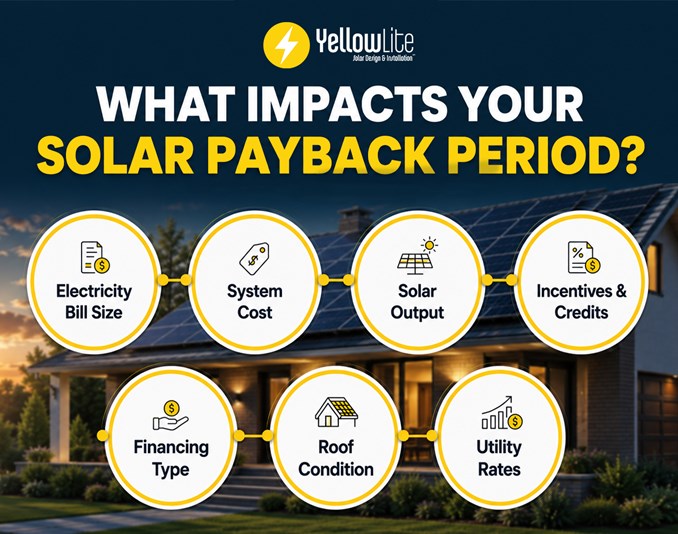
- Electricity bill size
- Solar system cost
- Energy production
- Incentives and credits
- Financing choice
- Roof condition
- Local utility rates
The goal is not just to reach payback quickly. The goal is to design a system that continues creating value after payback is reached.
Incentives That Can Improve Solar Savings
Incentives can reduce the effective cost of solar and improve ROI. However, incentive rules can change, so homeowners should always confirm current eligibility before making a final financial decision.
For residential solar, federal incentive rules have changed. The IRS states that the Residential Clean Energy Credit is not available for property placed in service after December 31, 2025. This makes it even more important to review current tax guidance before calculating expected savings.
Ohio net metering can also support savings by allowing eligible customers to receive credits for excess solar power sent back to the grid. In some cases, Solar Renewable Energy Certificates may add further value, depending on market availability.
The goal is not just to reach payback quickly. It is to choose a system that continues creating value long after payback is achieved.
Residential vs. Commercial Solar Savings
Solar savings work differently for homes and businesses, but both depend on the same foundation: accurate energy data, realistic savings projections, and a system designed around actual usage. Here’s how the savings focus usually differs:
|
Factor |
Residential Solar |
Commercial Solar |
|
Main Savings Goal |
Lower monthly electricity bills and improve long-term home energy stability. |
Reduce operating costs and improve long-term energy budget control. |
|
Best Fit For |
Homes with higher electricity use, strong sun exposure, future EV charging needs, or long-term ownership plans. |
Businesses with larger energy loads, available roof or ground space, and consistent daytime usage. |
|
ROI Advantage |
Savings build through monthly bill reduction, net metering credits, and long-term utility cost control. |
ROI may improve through larger system size, higher energy offset, tax planning, and depreciation benefits where applicable. |
|
Planning Focus |
Match the system to household usage, roof conditions, and future energy needs. |
Align system design with energy demand, business operations, cash flow, and long-term facility goals. |
How YellowLite Supports Smarter Solar Savings in Columbus
For Columbus homeowners and businesses, solar should begin with one clear question: how much do solar panels save over time? YellowLite helps customers look beyond the panels and understand the full financial picture, including solar panel savings, solar panel ROI, incentives, utility credits, and the expected solar panel payback period.
Our savings-focused approach includes:
- Energy usage review based on your current electric bill
- System planning built around long-term savings potential
- Equipment recommendations for reliable energy production
- Guidance on incentives, net metering, and financing options
- Ongoing support to help maintain system performance
The goal is not just to add solar to your property. It is to help you understand how solar can reduce electricity costs, improve long-term value, and support better energy planning.
Final Thought: Make Solar Savings Work for You
Solar energy in Columbus is not just about sustainability. It is about financial control, predictable energy costs, and long-term protection from rising utility bills. When solar panel savings, solar panel ROI, and the solar panel payback period are reviewed together, homeowners can make a more confident decision.
The smartest question is not only, “What does solar cost?” It is, “How much value can solar create over the life of the system?” Once you understand the numbers, it becomes easier to explore what a well-planned solar project could look like for your Columbus home or business.

FAQ
1. What financing options maximize solar panel savings?
Cash purchase usually offers the highest lifetime savings. Solar loans can also work well if monthly payments stay lower than expected energy savings.
2. What is the typical monthly electricity bill reduction with residential solar?
The reduction depends on system size, electricity usage, sunlight, and utility rates. A properly sized system can significantly offset monthly grid electricity costs.
3. How much do solar panels save on electricity bills?
Solar panels save by reducing the electricity you buy from the grid. Higher energy usage and strong sunlight usually increase savings potential.
4. What affects solar panel ROI the most?
Solar panel ROI depends on system cost, bill reduction, incentives, financing terms, equipment performance, and how long you use the system.
5. How long is the solar panel payback period?
The solar panel payback period is the time it takes for savings to recover system cost. It varies by usage, incentives, and financing.
5. Do solar incentives improve savings?
Yes, incentives can lower upfront or effective system cost. This may improve solar panel ROI and shorten the payback period.