


Electricity costs are going up as we move into 2026. Across Ohio and the Midwest, homeowners are seeing higher electric bills driven by increased demand from AI and data centers, volatile fuel prices, and grid upgrades. As a result, many households are re-evaluating long-term energy choices, and solar leasing has emerged as a popular option for those who want predictable electric costs without a large upfront investment.
But how much can solar leasing really save you in 2026? And how does it compare to buying solar panels outright, especially if you plan to sell your home someday?
This in-depth guide breaks down solar leasing costs, savings, and trade-offs, helping you decide whether leasing fits your financial goals. We’ll also walk through resale considerations and explain why working with a trusted local installer like YellowLite can make all the difference.
Key Overview
- Solar leasing provides predictable monthly payments, immediate bill savings, and zero upfront costs, making it an attractive option for homeowners facing rising electricity rates in 2026.
- In 2026, solar leasing typically costs $70–$130 per month for most homes, often reducing overall energy expenses compared to increasing Ohio utility bills.
- Over a 20-year term, solar leasing can deliver $6,000–$10,000 in savings, especially when utility rates rise faster than lease escalator clauses.
- Solar leasing agreements usually include maintenance, performance monitoring, repairs, and inverter replacement, giving homeowners a hassle-free and low-risk transition to clean energy.
- When comparing solar leasing vs buying solar, leasing prioritizes short-term cash flow stability, while ownership focuses on maximizing long-term return on investment.
What Is Solar Leasing?
Solar leasing is a financing option where a homeowner pays a fixed monthly fee for a solar energy system installed on their roof, without owning the equipment.
How solar leasing works
- A solar provider installs and owns the solar panels
- You pay a monthly lease payment to use the system
- The electricity produced offsets your usage on your electric bill
- Your lease payment is lower than what you are saving on your electric bill.
- Maintenance, monitoring, and insurance are typically included
Solar leasing vs owning solar
- Leasing: Lower upfront cost, less maintenance, lower lifetime savings
- Owning: Higher upfront cost (or loan), maximum long-term savings, tax incentives
Solar leasing is often chosen by homeowners who want immediate bill relief and low hassle, while ownership appeals to those focused on long-term return on investment.
How Much Does Solar Leasing Cost in 2026?
In 2026, solar lease pricing remains competitive, especially compared to rising utility rates.
Average solar lease payments
- $70–$130 per month for a typical 6–8 kW residential system
- Payment depends on system size, roof layout, and local sunlight
What’s included in a solar lease?
- System maintenance & repairs
- Performance monitoring
- Insurance coverage
- Inverter replacement (if needed)
This bundled approach is a major reason solar leasing appeals to homeowners who prefer predictable costs.
How Much Can Solar Leasing Save You?
The big question: How much can you save by leasing solar panels?.
Monthly utility bill comparison
Typical Ohio homeowner in 2026:
- Pre-solar utility bill: $160–$200/month
- Post-lease combined cost (utility + lease): $120–$150/month
That’s an immediate monthly savings of $20–$50, even without owning the system.
10-year vs 20-year savings
- 10 years: $2,500–$5,000 in net savings
- 20 years: $6,000–$10,000+ depending on utility inflation
Savings grow when:
- Utility rates rise faster than lease escalators
- Homes have strong solar exposure
- Zero-escalator leases are used
Savings shrink when:
- Escalators are high
- Energy usage is low
- Utility rates decrease (yeah right…)
Explore how Solar Panels for Home: The Smartest Energy Investment in 2026 can help you lock in long-term savings and energy independence.
Solar Leasing vs Buying Solar Panels
Here’s a clear side-by-side comparison to help you evaluate solar lease vs buying solar:
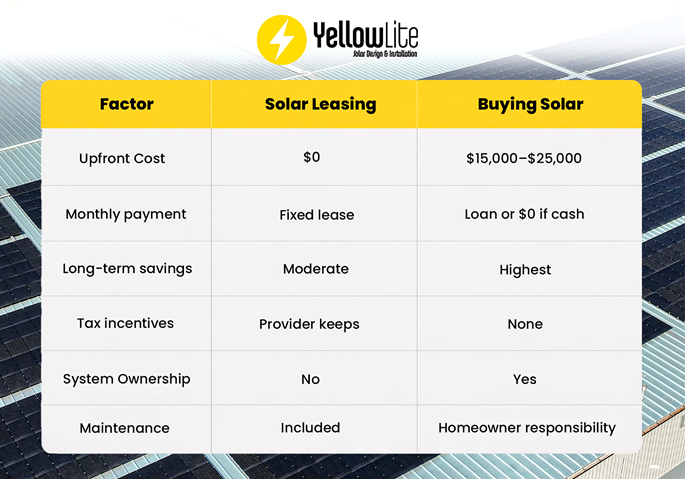
For homeowners comparing solar financing options, the decision usually comes down to cash flow vs long-term equity.
Buying a Home with Leased Solar Panels – What to Know
Many buyers worry about buying a home with leased solar panels, but it doesn’t have to be a dealbreaker.
Lease transfer basics
- Leases are typically transferable to the buyer
- Buyer must qualify for credit approval
- Terms remain the same unless renegotiated
Impact on resale value
- Homes with leased solar can still sell competitively
- Transparency is key: disclose savings history
- Buyers often appreciate lower utility bills
Common buyer objections and solutions
- “I don’t want a long contract.” → Offer buyout option at closing
- “I want ownership.” → Transfer + post-sale purchase option
- “What if it underperforms?” → Show performance guarantees
With proper guidance, buying a home with leased solar panels can be smooth and stress-free.
Pros and Cons of Solar Leasing
Pros
- Low or no upfront cost
- Maintenance and monitoring included
- Faster access to solar savings
- Predictable monthly payments
Cons
- Lower lifetime savings vs ownership
- No solar tax credit for homeowners
- Contract length (20–25 years typical)
- Escalator clauses can reduce savings
Understanding these trade-offs is essential before deciding whether solar leasing is worth it for you.
Is Solar Leasing Worth It in 2026?
Solar leasing makes sense for homeowners who:
- Want immediate bill relief without upfront costs
- Prefer simplicity and maintenance-free systems
- May not qualify for large solar loans
- Plan to stay in the home for at least 7–10 years
Ownership may be better if you:
- Want maximum ROI
- Plan to stay long-term
- View solar as a home equity investment
There’s no one-size-fits-all answer, which is why comparison matters.
Why YellowLite Recommends Comparing Before Committing
At YellowLite, we take an education-first approach to solar financing.
What sets our guidance apart
- Side-by-side lease vs ownership analysis
- Utility-rate forecasting based on Midwest data
- Transparent breakdown of escalators and buyouts
- Local expertise tailored to Ohio and neighboring states
Our goal isn’t to push one option; it’s to help you figure out if solar makes sense for you, then choose the right one.
Conclusion
Solar leasing in 2026 offers a practical path to clean energy with lower upfront risk and immediate savings, but it’s not without trade-offs. While lifetime savings are typically lower than ownership, leasing can still protect you from rising electricity costs and simplify your transition to solar.
The smartest move? Compare before committing.
If you want a clear picture of solar lease cost, solar lease savings, and ownership alternatives, a personalized analysis can help you make the most informed decision, without pressure.
Talk to one of our solar experts. Compare leasing vs ownership. Make the choice that fits your future.

FAQs
1. Is solar leasing cheaper than buying?
In the short term, yes. But, over 20–25 years, ownership usually delivers higher total savings.
2. Can I sell my home with leased solar panels?
Yes. Most leases are transferable or can be bought out during the sale.
3. Does solar leasing increase home value?
It can, especially when buyers value predictable energy costs—but ownership typically adds more value.
4. Are maintenance costs included in a solar lease?
Yes. Maintenance, monitoring, and repairs are usually included.
5. Is solar leasing a good option in Ohio?
For many homeowners facing rising utility rates, solar leasing can offer immediate and predictable savings.