



If you’re trying to understand where your household electricity goes, your refrigerator is a logical place to begin. It runs continuously, day and night, making it one of the few appliances in your home that never truly shuts off.
With a bit of basic information and simple math, you can determine how much electricity your refrigerator uses, what it costs annually, and whether solar panels are a practical solution. No electrician or technical background required.
This guide explains refrigerator wattage, how it translates to energy costs, and why powering a single appliance with solar is usually not the most cost-effective approach.
Key Overview:
- Most residential refrigerators use between 100–600 watts, with modern models averaging 150–300 watts, contributing roughly 8–10% of total household electricity use.
- Electricity costs are measured in kilowatt-hours (kWh), meaning refrigerator wattage combined with daily run time determines its annual energy cost on your utility bill.
- A typical refrigerator consumes 350–700 kWh per year, costing homeowners approximately $60–$150 annually, depending on local electricity rates.
- Powering a refrigerator with solar energy is technically simple, as one 300-watt solar panel can offset a standard refrigerator’s energy use.
- From a financial standpoint, solar systems deliver greater savings when designed to offset high-consumption loads like heating and air conditioning, rather than powering a single appliance.
What Is a Watt and How Does It Relate to Refrigerator Energy Use?
A watt is a unit of power that measures how much electricity an appliance uses at a specific moment in time.
However, electric utilities bill customers based on kilowatt-hours (kWh), which represent energy usage over time:
- Kilowatts (kW) measure power
- Hours (h) measure duration
In simple terms, watts tell you how powerful an appliance is, while kilowatt-hours determine how much energy an appliance uses, which influences how much your electric bill costs.
Understanding this distinction is essential before estimating refrigerator energy usage.
How Many Watts Does a Refrigerator Use?
To find your refrigerator’s power rating, check the manufacturer’s label located inside the unit or on the back. It may be listed as:
- Rated Power
- Power Consumption
- Watts (W)
Typical Refrigerator Wattage
Most residential refrigerators fall within these ranges:
- 100–600 watts
- Most commonly 150–300 watts
For this example, we’ll assume a refrigerator rated at 300 watts.
How Many Watts Does A Refrigerator Draw?
Although a refrigerator runs continuously, it does not draw full power at all times. The compressor cycles on and off throughout the day.
On average:
- Daily usage: 1–2 kWh
- Annual usage: 350–700 kWh
Depending on local electricity rates, this typically costs $60–$150 per year.
Curious about your home’s energy usage? Find out how many kWh a house typically uses and what affects it.
How Many Solar Panels Would It Take to Power a Refrigerator?
You can estimate the number of solar panels required using a simple calculation:
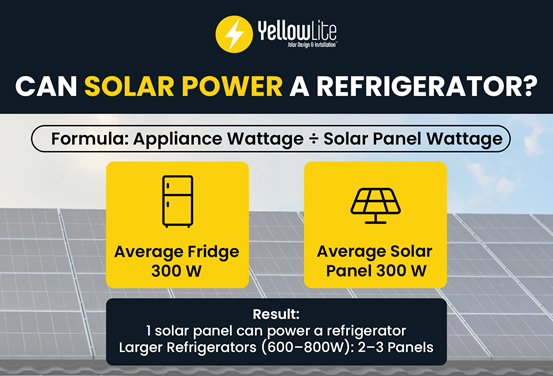
Appliance wattage ÷ Solar panel wattage
Most residential solar panels produce between 250 and 400 watts, with 300 watts being a common standard.
Example:
- Refrigerator: 300 watts
- Solar panel: 300 watts
This means one solar panel could theoretically power a refrigerator. Even larger refrigerators using 600–800 watts would require only two to three panels.
Use the YellowLite solar energy calculator to estimate how many panels you’ll need based on your appliance usage.
Should You Install Solar Panels Just to Power a Refrigerator?
In most cases, the answer is no.
While refrigerators run continuously, they typically account for only 8–10% of a home’s total electricity consumption. The largest energy users in most homes are:
- Heating and air conditioning (approximately 50%)
- Water heaters
- Lighting
- Appliances such as refrigerators
Solar installations involve fixed costs for equipment, labor, permitting, and interconnection. Installing solar panels solely to offset a small portion of your energy usage is rarely the most economical approach.
Where Solar Provides the Greatest Value
The average residential solar system includes 20–25 panels because it is designed to offset the home’s annual energy usage, which is impacted more heavily by larger appliances such as heating and cooling.
Many homeowners choose partial solar systems to:
- Stay within a defined budget
- Reduce exposure to rising utility rates
- Offset high-cost energy usage rather than minor loads
From a financial perspective, solar delivers the strongest return when it targets energy-intensive systems such as air conditioning, heat pumps, or whole-home consumption during peak hours.
A Smarter Approach With YellowLite
Refrigerators use a modest portion of household energy and require very few solar panels to offset. However, solar delivers the greatest value when designed to address the largest energy demands in your home.
At YellowLite, we help homeowners design solar systems that prioritize:
- High-impact energy usage
- Available tax incentives and net metering benefits
- Long-term financial efficiency
Whether you’re interested in offsetting part of your electricity use or planning a broader solar solution, thoughtful solar energy system design is key to maximizing savings.

FAQ
1. How many watts to power a refrigerator?
Most residential refrigerators require 150 to 300 watts to power a refrigerator during normal operation. Larger or older models may need up to 600 watts, while startup surge power can be higher for short periods.
2. How many watts are in a fridge?
If you’re wondering how many watts in a fridge, the answer depends on size and efficiency. Most modern refrigerators operate between 100 and 600 watts, with the average household fridge using around 150–300 watts.
3. How many watts does a refrigerator draw when running?
On average, how many watts a refrigerator draws while running ranges from 150 to 300 watts. The compressor cycles on and off, so the refrigerator does not draw maximum wattage continuously throughout the day.
4. Does refrigerator wattage affect electricity cost?
Yes. The higher the refrigerator power rating, the more electricity it consumes over time. While wattage shows instant power draw, total cost depends on kilowatt-hours (kWh) used per day and your local electricity rate.
5. How many solar panels are needed to run a refrigerator?
In most cases, one 300-watt solar panel is enough to run a standard refrigerator that draws 150–300 watts. Larger refrigerators with higher power ratings may require two to three panels, depending on energy usage and available sunlight.