

When businesses consider solar energy, they’re often focused on the equipment, incentives and projected savings. But in the realm of commercial solar installations, one factor stands out above the rest: the choice of your commercial solar installer. The right partner can unlock maximum financial and operational value; the wrong one can reduce savings, delay payback and complicate maintenance. This article explores how that choice influences your return on investment (ROI) on solar panel installation.
Key Takeaways
- The quality of your commercial solar installer directly determines system performance, long-term energy output, and overall ROI, even when using the same panels and incentives.
- A skilled installer enhances ROI by conducting accurate site audits, optimizing design for industrial load profiles, and ensuring compliance with permitting and interconnection standards.
- Poor installer choice leads to under-designed systems, hidden losses, higher degradation, and delayed payback, ultimately shrinking your return over 20–25 years.
- Top commercial solar installers influence critical financial metrics like yield, payback period, IRR, NPV, and maintenance costs, ensuring predictable energy savings.
- Choosing an experienced, engineering-driven installer protects your investment through premium components, performance guarantees, and long-term monitoring and maintenance, strengthening financial and operational outcomes.
Why Installation Quality Is Fundamental to ROI
In installations targeted at industrial and commercial operations - where solar panels for industry must deliver across tens or hundreds of kilowatts, every detail matters. A strong ROI in commercial solar does not derive merely from lower panel cost or a big tax credit; instead it comes from consistent high performance, minimal losses, and longevity of output.
For example: One blog on commercial solar ROI argues that “a well-designed system that carries with it a higher price often delivers a better commercial solar ROI than a lower-cost system designed and installed by an inexperienced solar installer.” Namaste Solar
When you hire the right commercial solar installer:
- They will audit your site properly: roof strength, shading, orientation, industrial load profile.
- They will optimise panel placement, tilt, wiring, and system balancing for your industrial demand, which supports long-term output and thus stronger ROI.
- They will manage permitting, utility interconnection and ongoing maintenance planning, avoiding hidden costs and delays.
- They will also understand local utility rates and policies to ensure the system is designed for maximum savings and the best financial performance.
Conversely, the wrong installer may under-design the system, miss local permitting quirks, or choose cheaper components that degrade faster — all of which reduce your effective return from solar.
Key Metrics That a Great Installer Will Influence
Here are several performance and financial metrics where the installer plays a decisive role:
- System output vs. expected yield: Solar panel for industry systems depend on actual production. If an installer fails to model correct site conditions, your yield drops and ROI suffers.
- Payback period: Industry data show average payback around 10 years for commercial solar, but with proper design and optimisation this can be reduced.
- Internal Rate of Return (IRR) and Net Present Value (NPV): These financial metrics depend heavily on installation cost, system performance, maintenance costs and offset electricity rates - all areas where installer quality matters.
- Lifetime system performance and maintenance issues: A proper commercial solar installer anticipates components (inverter, panels) replacement, warranty conditions, and ongoing monitoring programs - thereby protecting your ROI against hidden losses.
In short: even if you pick the same panels and similar incentives, the difference in ROI between an elite installer and an average one can be significant.
What to Look for When Choosing a Commercial Solar Installer
Choosing the right provider for your solar power commercial installations isn’t just about cost. Here are criteria that separate strong partners from maybe-adequate ones:
a. Industry experience & references
Look for companies with proven track records in industrial or large-scale systems (not just residential). Ask for commercial solar references (warehouses, manufacturing plants, large rooftops, carports). Ensure their installations achieved the promised performance.
b. Engineering & design capabilities
A top commercial solar installer will have in-house or contracted engineering staff who understand structural loads, thermal expansion, industrial electrical demand, and site-specific factors like demand-charge reduction. They should present modelling for your facility’s load profile and how solar will offset it.
c. Full-service offering and maintenance plan
Because commercial systems are capital investments, you’ll want a partner who offers turn-key services: permitting, interconnection, commissioning, monitoring dashboard, maintenance contracts. Without this, your panels for industry risk under-performance over time.
d. Realistic performance expectations
The right installer will provide clear data: system size (kW), expected annual kWh output, assumed utility escalation rate, maintenance costs, payback period and ROI projections.
e. Quality of components & warranties
Make sure the installer uses high-efficiency panels, industrial-grade inverters, robust mounting solutions. Also check warranties: equipment, workmanship, performance guarantees. Poor components = higher risk of degraded output and lower ROI.
Common Mistakes That Undermine Commercial Solar ROI
Even businesses that intend to invest wisely in solar sometimes miss important factors — and these mistakes often trace back to installer choice or oversights in the installer evaluation. Some of the frequent missteps include:
- Underestimating demand charges: Industrial facilities often incur high demand-charge fees. If your solar design doesn’t address peak loads, the savings will be less than expected.
- Ignoring future expansion or operational changes: The right installer will design for flexibility (e.g., adding storage or charging infrastructure) so you don’t end up with a system that needs costly upgrades.
- Selecting installers based solely on lowest cost: Lower bids might cut corners on design, components or monitoring. As one article puts it: “price vs. value” is critical.
- Neglecting maintenance and degradation: Even commercial solar systems require monitoring, occasional cleaning, inverter replacement. If these are not planned, output drops and ROI shrinks.
- Failing to align with business energy profile and goals: If you install panels for industry without matching them to your actual load pattern, you may offset only a fraction of your usage or miss opportunities like demand-charge reduction.
Why Timing, Incentives and Utility Rates Interact with Installer Quality
The financial case for commercial solar installations is strengthened by incentives (tax credits, depreciation), rising utility rates, and favourable payback timelines. But these benefits can only be realised fully if the system is well-designed and installed.
- Rising electricity rates increase the value of each kilowatt-hour your system offsets, so as the cost for energy goes up, your savings increase over time.
- Government incentives (for example, the federal investment tax credit) reduce upfront costs, but the overall ROI still depends on system performance and longevity.
- Utility structures are changing: time-of-use, demand charges, grid integration. A skilled commercial solar installer anticipates these factors and optimises accordingly.
In short: the window for maximum benefit may be influenced by timing, but the impact of the installer remains constant - even more so when timing is critical.
Case Example: How Installer Choice Altered ROI
Imagine two manufacturing plants each install a 500 kW solar array. Plant A selects a budget installer with limited commercial experience; Plant B selects a seasoned commercial solar installer specialised in industrial loads.
- Plant A’s system is undersized for peak demand, uses standard mounting (not optimised for industrial rooftop), and lacks advanced monitoring. Its annual yield is 15% below projections due to shading and wiring losses.
- Plant B’s installer designed with full load profiling, optimised panel layout, offered performance warranty and maintenance contract. Its yield meets or exceeds projections.
Over 20 years, Plant B ends up with thousands more dollars in savings, higher IRR, and fewer surprises. This example underscores why the installer matters.
Checklist for Executives: Questions to Ask Your Commercial Solar Installer
Before you sign any contract for solar panels for commercial installations, you must ask these.
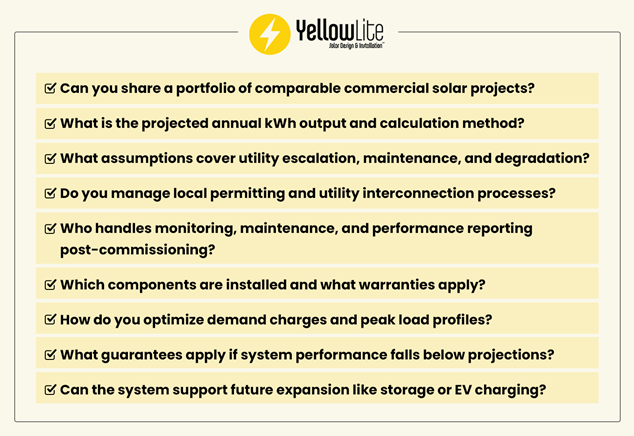
A quality commercial solar installer will answer confidently, provide documentation and allow you to benchmark their proposal against other offers.
Conclusion: The Installer Is the Investment
In commercial solar, success isn’t just about panels or sunlight - it’s about execution. The right commercial solar installer is your most valuable asset, shaping everything from initial design to 25-year performance. They determine how efficiently your system runs, how quickly you recover your investment, and how reliably you’ll generate clean power for decades.
As energy costs rise and sustainability becomes a corporate priority, partnering with an experienced, engineering-led installer isn’t optional - it’s essential.
That’s where YellowLite stands out. With over a decade of expertise in solar power commercial installations across Ohio and the Midwest, YellowLite combines precision engineering, premium equipment, and transparent ROI modelling to deliver results businesses can count on. From initial assessment to lifetime monitoring, YellowLite ensures your solar panels for industry work as hard as you do - powering profitability and sustainability side by side.
Choosing wisely today means protecting your bottom line for years to come.
Frequently Asked Questions
Q1: How much do commercial solar installations typically cost?
Costs vary depending on size and complexity, but most solar power commercial installations range between $1 to $2 per watt. The right commercial solar installer will provide a precise estimate based on your energy profile and site conditions.
Q2: How long does it take to see ROI from solar panels for industry?
The payback period usually ranges from 5 to 10 years. However, experienced installers often shorten this timeline through optimized design, load management, and incentive coordination.
Q3: What kind of maintenance do industrial solar systems require?
Minimal but regular. Professional commercial solar installers offer monitoring, periodic cleaning, and inverter servicing to maintain consistent output and extend system life.
Q4: Can my existing facility handle a solar array?
That depends on your roof or land structure. A qualified commercial solar installer will conduct structural assessments and shading analysis to ensure your site is solar-ready.
Q5: Do solar panels work efficiently for energy-intensive industries?
Yes. For factories, warehouses, and data centers, solar panels for industry reduce grid reliance and demand charges, cutting energy expenses dramatically.
Q6: Are there financing or leasing options for commercial systems?
Absolutely. Many commercial solar installers offer Power Purchase Agreements (PPAs), leases, or loan structures that let businesses go solar with minimal upfront investment.
Q7: What warranties should I expect from a commercial solar project?
Look for 25-year performance warranties on panels and 10–15 years on inverters, plus workmanship coverage. Reliable installers handle warranty claims directly with manufacturers.
Q8: How can I ensure my system performs as promised?
Ask your commercial solar installer about performance guarantees and monitoring dashboards. Real-time data visibility helps you track output and financial performance over time.